
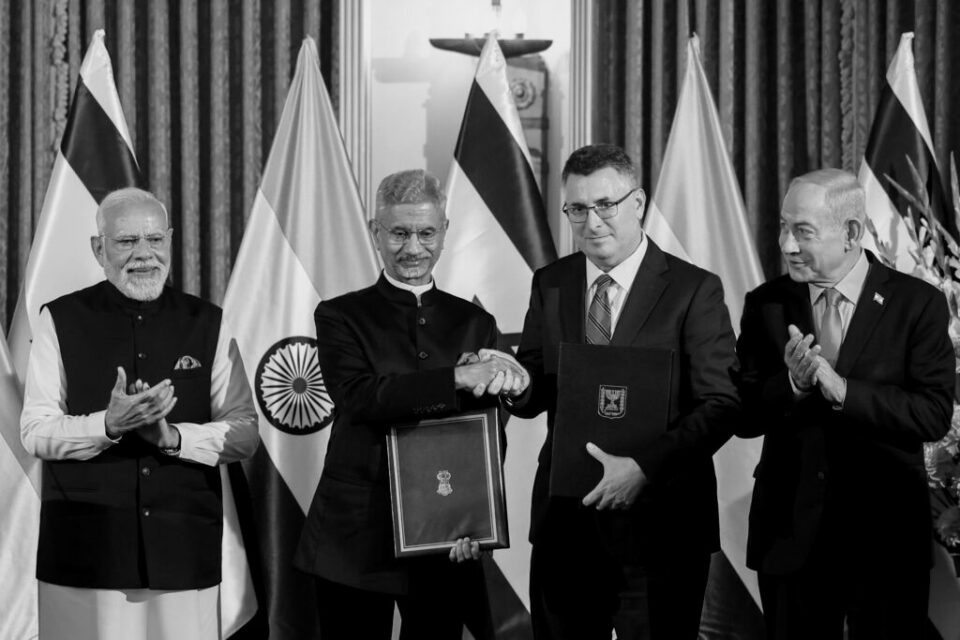
India and Israel on Thursday announced 27 key outcomes following Prime Minister Narendra Modi’s two-day state visit to Israel, marking a significant expansion of cooperation across technology, trade, agriculture, education and strategic sectors.
The announcements were made after wide-ranging talks between Prime Minister Modi and Israeli Prime Minister Benjamin Netanyahu. According to the Ministry of External Affairs (MEA), the outcomes include 17 agreements and Memorandums of Understanding (MoUs), along with 10 major announcements aimed at deepening both strategic and people-centric engagement.
Partnership Elevated to New Strategic Level
In his media statement, Prime Minister Modi described the relationship as built on “deep trust, shared democratic values and human compassion.” He announced that both countries have decided to elevate their existing Strategic Partnership—established in 2017—to a “Special Strategic Partnership.”
“Our relationship has stood the test of time. This historic decision reflects the aspirations of the people of both countries,” Modi said.
He also reiterated that India’s security interests are closely linked to peace and stability in the Middle East, while reaffirming New Delhi’s position in favour of a peaceful resolution to the Gaza conflict.
Technology and Artificial Intelligence at the Core
A strong emphasis was placed on emerging technologies, particularly Artificial Intelligence.
Key developments include:
-
An MoU on AI cooperation covering ethical development, civilian applications and research collaboration.
-
An agreement to advance AI-powered education, focusing on teacher development and equitable digital access.
-
A Declaration of Intent on Horizon Scanning to enhance strategic foresight using AI-driven tools.
-
Launch of a new initiative on Critical and Emerging Technologies led by India’s National Security Advisor.
A Letter of Intent was also signed to establish an Indo-Israel Cyber Centre of Excellence in India, aimed at strengthening cybersecurity capabilities.
Trade, Investment and Financial Cooperation
Economic engagement was highlighted as a central pillar of bilateral ties.
Modi noted that a bilateral investment agreement signed last year is already promoting mutual investments, and both sides aim to finalise a Free Trade Agreement (FTA) soon.
Financial cooperation was expanded through:
-
An MoU between India’s International Financial Services Centres Authority (IFSCA) and Israel Securities Authority (ISA).
-
Launch of a new Financial Dialogue mechanism.
-
Establishment of a Tech-Gateway Initiative.
Additionally, NPCI International (NIPL) and Israel’s MASAV signed an MoU to facilitate cross-border remittances using India’s Unified Payments Interface (UPI).
Agriculture, Fisheries and Resource Management
Agricultural collaboration received a major boost with the establishment of the India-Israel Innovation Centre for Agriculture (IINCA) through cooperation between ICAR and MASHAV. The centre will focus on precision farming, satellite irrigation, pest management and post-harvest technologies.
An MoU on Fisheries and Aquaculture was also signed to promote sustainable and technology-driven marine practices.
In the energy and minerals sector, an agreement on geophysical exploration will use advanced geophysical and AI technologies to promote sustainable resource development.
Maritime Heritage and Cultural Exchange
The two countries also agreed to collaborate on the National Maritime Heritage Complex (NMHC) at Lothal, Gujarat, highlighting shared maritime history.
A Cultural Exchange Programme (2026–2029) was signed to deepen cooperation in music, theatre, visual arts and cultural exchanges.
Labour Mobility and Workforce Expansion
Three Implementation Protocols were signed to facilitate regulated recruitment of Indian workers in sectors including manufacturing, services and hospitality.
Both sides agreed on a quota of up to 50,000 Indian workers over the next five years, covering industries such as retail, logistics, textiles, electronics and food services.
Academic and Research Collaboration
Academic engagement was expanded through:
-
An MoU between Nalanda University and the Hebrew University of Jerusalem.
-
Establishment of an India-Israel Academic Cooperation Forum.
-
20 Joint Fellowships in Agricultural Research.
-
Enhanced joint research funding initiatives.
The Joint Committee on Science and Technology was also elevated to the Ministerial level.
Institutional and Parliamentary Engagement
The leaders announced the formation of an India-Israel Parliamentary Friendship Group and acknowledged recommendations from the 4th India-Israel CEO Forum held in November 2025.
Strategic Implications
The visit marks one of the most comprehensive expansions of India-Israel ties in recent years. By combining technology collaboration, economic integration and people-to-people exchanges, the upgraded partnership signals a long-term institutional framework beyond sector-specific cooperation.
With emerging technologies and workforce mobility at the centre, the relationship appears set to move from transactional engagement to structured strategic alignment.
