
Hyderabad: In many villages, raising a complaint often means time, travel and uncertainty.For years, people have had to visit offices, wait for officials or depend on intermediaries to get even basic civic issues addressed. For some, the process itself becomes the biggest hurdle.
The “Praja Darbar” programme being rolled out in Telangana is trying to change that pattern — by bringing the system to the people instead of the other way around.
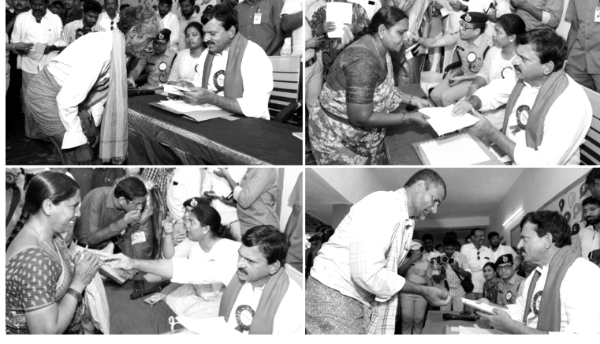
Launched in Paleru, the initiative is designed as a direct interface between citizens and the administration. On the ground, it looks simple: officials sit across tables, residents gather with their concerns, and conversations begin.
But behind that simplicity is a shift in approach.
A different kind of interaction
At the Praja Darbar in Paleru, people from nearby gram panchayats walked in with a range of issues — water supply problems, electricity concerns, housing requests, land disputes.
Instead of being redirected from one department to another, they were able to speak directly to officials handling those matters.
Some issues were resolved immediately. Others were noted, recorded and taken up for follow-up.
For many, the difference was not just in the response, but in being heard without layers of process.
Why such a programme matters
In rural areas, access is often the biggest challenge.
Even when schemes exist, reaching the right office or understanding procedures can delay solutions. Over time, this creates a gap between what is promised and what is experienced on the ground.
Praja Darbar attempts to reduce that gap.
By taking officials into villages and creating a space for direct dialogue, the programme aims to make governance more visible and approachable.
The kind of issues being raised
The concerns brought forward reflect everyday life.
Water availability, electricity connections, housing support and land-related matters form the bulk of complaints. Among these, land issues — especially those linked to records and ownership — remain one of the most sensitive areas.
Housing schemes are another major focus, as they directly affect families waiting for support.
These are not abstract policy issues. They are immediate concerns, often tied to livelihood and basic living conditions.
A model in progress
Paleru has been chosen as the starting point, but the plan is to expand the programme across Telangana.
Officials say this is not meant to be a one-day event, but a continuing process where issues are tracked and followed up.
The real test, however, will be in what happens after the interaction — whether the recorded complaints are resolved within a reasonable time.
Changing expectations
When people see officials at their doorstep, expectations change.
The interaction becomes more direct, and accountability becomes more visible. At the same time, it also places pressure on the system to respond consistently.
For the administration, it is not just about listening, but about delivering outcomes.
The road ahead
The government plans to hold review meetings with district officials to monitor progress, especially in departments dealing with revenue and housing.
This follow-up will be crucial in determining whether Praja Darbar becomes a sustained model or remains limited to outreach events.
The takeaway
Praja Darbar is not just about solving individual complaints.
It reflects an attempt to rework how governance is experienced at the grassroots — making it less distant, more accessible and easier to engage with.
For people who often see the system from a distance, even that shift can make a difference.
The real measure, however, will lie beyond the meetings — in how many of those conversations turn into actual solutions.
