
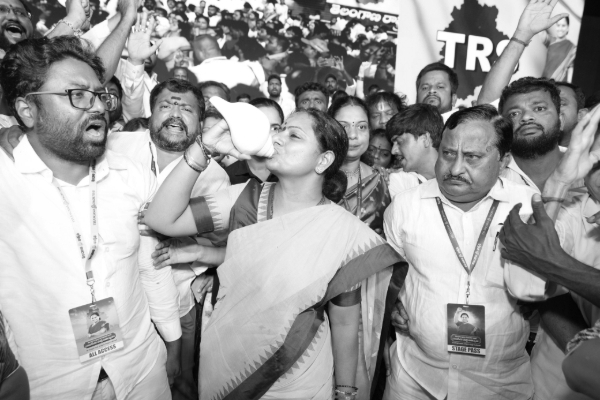
Hyderabad: The launch of a new political party rarely comes without a message. In the case of K Kavitha, that message was layered — part reflection, part criticism, and part attempt to reposition herself in Telangana’s political space.
At a large public meeting in Muneerabad, Kavitha announced the formation of Telangana Rashtra Sena, reviving a name that echoes the earlier identity of the state’s regional politics. The choice of name itself carried a clear signal — a return, at least in narrative, to the original Telangana movement.
What is she trying to say
Kavitha’s speech was not just about launching a party. It was about explaining why she felt the need to do so.
She acknowledged her own association with the earlier government and admitted that not everything had gone as expected. At the same time, she positioned the new party as an attempt to “correct” that course.
Her central argument was simple: the Telangana that people had hoped for has not fully taken shape.
This framing places her not as an outsider, but as someone who was inside the system and is now stepping out to challenge it.
A shift in tone
What stood out was the tone.
There was a mix of criticism and introspection — something not often seen in conventional political launches. Kavitha spoke about gaps in governance, concerns raised by farmers and sections of society, and the feeling that the focus had shifted from people to power.
She also made it clear that her new political journey would not be limited to one opponent. Her criticism extended across parties, including the ruling establishment and her former political space.
Positioning herself differently
Kavitha tried to present herself in a distinct way — not just as a political leader, but as someone who wants to build an emotional connection with people.
Her reference to being an “Amma”-like figure suggests an attempt to move towards a welfare-driven, people-centric leadership style, one that relies on both policy promises and personal outreach.
This is a familiar model in Indian politics, but applying it in Telangana adds a new layer to the state’s political narrative.
Key promises
The new party’s agenda was outlined through a set of broad commitments.
Education, healthcare, agriculture, employment and social justice formed the core themes. The promises were expansive — from free access to education and healthcare to large-scale job creation and support for farmers.
While these ideas are not entirely new, the emphasis was on implementation and accessibility.
The message being projected is that governance should feel direct and responsive, not distant.
What it means politically
The launch comes at a time when Telangana’s political space is already competitive.
A new party, especially one led by a known political figure, could influence voter equations in certain segments — particularly youth, activists and sections that feel disconnected from existing parties.
However, translating that into electoral success will depend on organisation, outreach and consistency over time.
At this stage, the move is more about signalling intent than immediate impact.
The challenges ahead
Starting a new political platform is not easy.
Beyond messaging, it requires building a ground-level network, establishing credibility and maintaining momentum after the initial launch.
There is also the question of how voters will respond — whether they see this as a genuine shift or a continuation of existing politics in a new form.
The takeaway
Kavitha’s party launch is not just an addition to the list of political players.
It is an attempt to reshape her role in Telangana politics — from being part of a past phase to presenting herself as part of a possible next phase.
Whether that shift connects with voters will become clear only over time.
For now, the launch has opened a new conversation in the state’s political landscape.
