
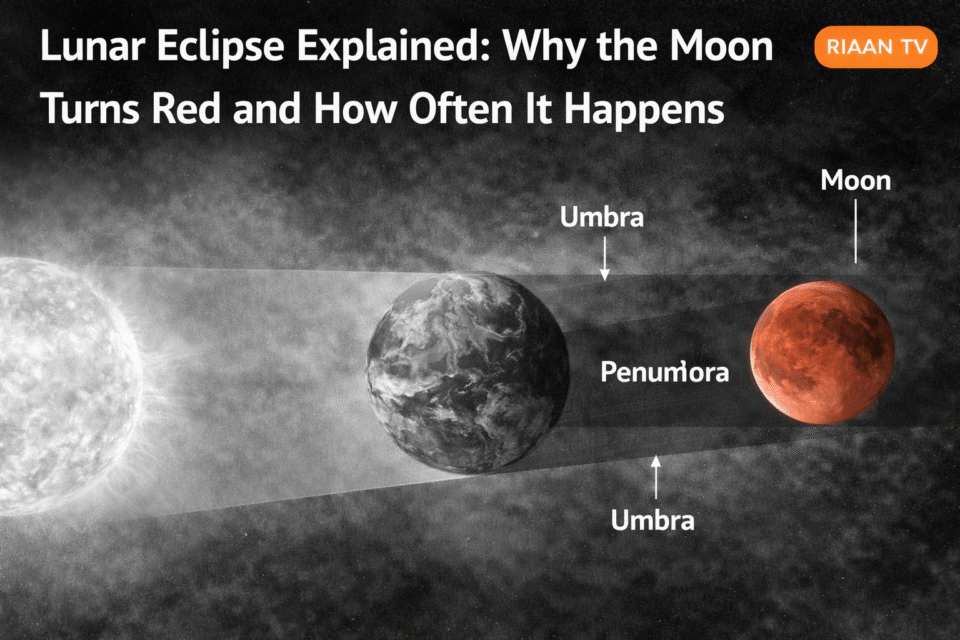
A lunar eclipse is one of the most striking natural events visible from Earth — a slow celestial transformation in which the bright full Moon gradually darkens and, in some cases, glows deep red.
Unlike solar eclipses, which require careful eye protection, a lunar eclipse can be safely observed without any equipment. All that is needed is clear skies and a view of the night sky.
How a Lunar Eclipse Happens
A lunar eclipse occurs when the Earth moves directly between the Sun and the Moon during a full Moon phase. As Earth blocks sunlight, the Moon passes into Earth’s shadow.
Because the Moon shines by reflecting sunlight, entering this shadow alters its appearance. Instead of its usual silver glow, the Moon dims — and during certain eclipses, it turns reddish.
This alignment does not happen every month, even though a full Moon occurs roughly every 29 days. The reason lies in the Moon’s tilted orbit. The Moon’s path around Earth is slightly angled, meaning it usually passes above or below Earth’s shadow. Only when the alignment is precise does an eclipse occur.
On average, there are about two to three lunar eclipses each year.
Why the Moon Appears Red
During a total lunar eclipse, the Moon can take on a copper or red tone. This happens because sunlight passes through Earth’s atmosphere before reaching the Moon.
The atmosphere scatters shorter blue wavelengths of light and bends longer red wavelengths into Earth’s shadow. The red light then illuminates the Moon’s surface.
The same process explains why sunsets and sunrises often appear red or orange.
Types of Lunar Eclipses
Not all lunar eclipses look the same. Their appearance depends on how deeply the Moon moves into Earth’s shadow.
• Total Lunar Eclipse: The entire Moon enters the darkest part of Earth’s shadow (umbra), often turning red.
• Partial Lunar Eclipse: Only a portion of the Moon moves into the dark shadow, creating a visible dark section.
• Penumbral Lunar Eclipse: The Moon passes through the lighter outer shadow. The dimming is subtle and sometimes difficult to notice.
A total lunar eclipse is usually the most visually dramatic and can last for several hours from beginning to end, although the fully red “totality” phase typically lasts around one hour.
Viewing a Lunar Eclipse
Lunar eclipses are completely safe to watch with the naked eye. No filters, glasses or telescopes are required.
For the best viewing experience:
• Choose an area away from city lights
• Ensure the sky is clear
• Find an open view without tall buildings or trees blocking the horizon
Because the process unfolds gradually, observers can watch the Moon slowly darken and then brighten again over time.
Why They Don’t Occur Every Month
Even though full Moons occur monthly, eclipses are less frequent due to the Moon’s five-degree orbital tilt. This slight angle usually keeps the Moon out of Earth’s shadow.
When the timing and alignment coincide, eclipses may occur in clusters within the same year.
What Is a “Super Blood Moon”?
The Moon’s distance from Earth changes slightly during its orbit. When it is closest, it appears larger and brighter — a phenomenon often called a “supermoon.”
If a total lunar eclipse happens during this time, it is sometimes informally referred to as a “super blood Moon.” While the term is popular, astronomically it simply describes a total eclipse occurring near the Moon’s closest orbital point.
When to Watch in the Coming Years
Over the next decade, several lunar eclipses will be visible from different parts of the world. Some will be partial, while a few will be total eclipses observable across Europe, Asia and other regions.
Visibility depends on geographic location and weather conditions, so checking local astronomical calendars closer to the date is recommended.
A Rare Alignment, A Quiet Spectacle
Unlike dramatic meteor showers or fleeting solar eclipses, a lunar eclipse unfolds slowly and silently. It is a reminder of the precise movements of celestial bodies and the natural rhythms governing Earth, Moon and Sun.
With no equipment required and no safety risks involved, it remains one of the most accessible astronomical events for observers around the world.
