
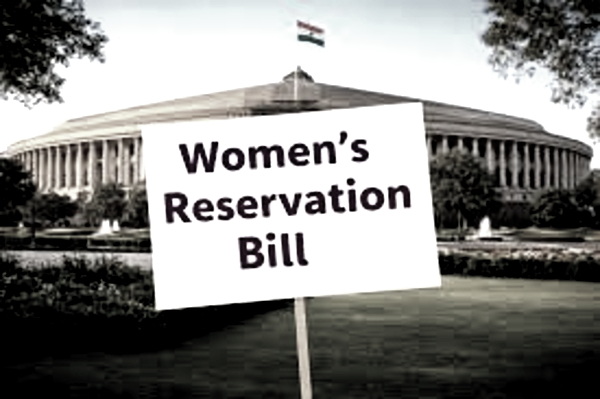
New Delhi: The Centre has notified the Women’s Reservation Act, bringing into force a long-pending provision that aims to increase women’s presence in legislative bodies across the country.
The law provides for reserving one-third of seats in the Lok Sabha and State Assemblies for women, marking a structural change in India’s electoral framework. Passed by Parliament in 2023, the legislation had remained in the implementation stage until now.
Government sources said the notification marks the beginning of the process that will eventually translate into higher representation of women in national and state-level politics.
Prime Minister Narendra Modi, reacting to the development, said the strength of women continues to define India’s progress, noting that their role across sectors has expanded significantly in recent years.
Without referring to the legislation directly, he highlighted the contribution of women in nation-building and said their participation is visible across multiple fields.
At the political level, responses have begun to emerge across party lines.
Parliamentary Affairs Minister Kiren Rijiju said the notification is part of the formal process required to operationalise the law. He maintained that the measure should be viewed as an institutional step rather than a political issue.
Among political representatives, reactions ranged from endorsement to calls for wider consensus.
BJP MP Dinesh Sharma described the move as overdue and said it opens space for greater participation of women in decision-making roles. He also said the development reflects a broader shift in governance priorities.
JD(U) MP Sanjay Jha said the step has come after a long delay and should receive uniform support. Referring to Bihar, he pointed out that higher representation of women at the Panchayat level has already created a base of leadership over the years.
From within the ruling party, MP Laxmi Verma said the law could change the composition of legislative bodies by enabling more women to enter electoral politics, adding that it aligns with long-term development goals.
What changes now
The law introduces reservation for women in Parliament and State Assemblies through a rotational system, under which seats will be earmarked in different constituencies in successive elections.
However, officials indicated that actual implementation will follow the delimitation process linked to future census data, meaning the transition will take place in phases.
Why it matters
India has seen growing participation of women in local governance due to reservation in Panchayats and municipal bodies. The extension of similar provisions to higher legislatures is expected to gradually reshape political representation.
Observers say the impact of the law will depend on how effectively it is implemented and how political parties adapt to the change in candidate selection.
For now, the notification signals movement on a reform that has been under discussion for years, with its full effect likely to unfold over the next electoral cycles.
