
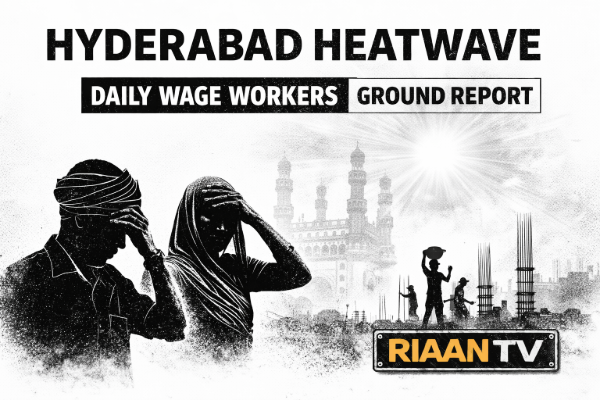
Hyderabad: The rising summer heat in the city is no longer just a weather update. It is visible on the streets — in slower movements, shorter tempers, and the visible strain on those who work outdoors.
For daily wage workers, the heat is not something to avoid. It is something they work through.
Across construction sites, roadside stalls and traffic junctions, work continues under direct sunlight. By mid-morning, the heat begins to settle in. By afternoon, it turns harsh.
During a visit to several parts of the city, including commercial areas and residential neighbourhoods, the pattern was similar. Workers were still at work, but with visible fatigue. Shade was limited. Breaks were brief.
A street vendor said afternoons have become harder to manage. “After 2 pm, it feels like heat is coming from all sides. But we cannot stop. If we stop, we lose the day,” he said.
For construction labourers, there is little flexibility. Work timings are fixed, and slowing down is rarely an option. Many cover their heads with cloth, some take short pauses, but most continue working through the peak hours.
Auto drivers face a different kind of strain. Long hours on the road, heat rising from the surface and constant traffic make conditions difficult. Some reduce working hours in the afternoon, but that directly affects earnings.
What is noticeable on the ground is how limited the coping options are. Water bottles, cloth coverings and short breaks are the only immediate responses available to most workers.
Public advisories on heat precautions are widely circulated, but for those dependent on daily income, avoiding peak hours is not practical.
In several areas, access to drinking water points, shaded spaces or rest zones remains uneven. Where available, they are quickly occupied. Where absent, workers rely on nearby shops or temporary arrangements.
The impact is not limited to discomfort. Prolonged exposure leads to fatigue, dehydration and reduced work capacity. For those paid on a daily basis, this also means reduced income.
Over the years, rising temperatures have turned this into a recurring situation. Yet, from a ground perspective, it continues to be managed individually rather than through structured support.
There is a clear gap between advisories and working realities.
As the city expands and summers become more intense, the need for practical measures becomes more visible — accessible water points, shaded rest areas and flexible arrangements in high-exposure zones.
For now, many continue to rely on personal adjustments to get through the day.
Because for a large section of the city, the heat is not a disruption.
It is part of the routine.
