
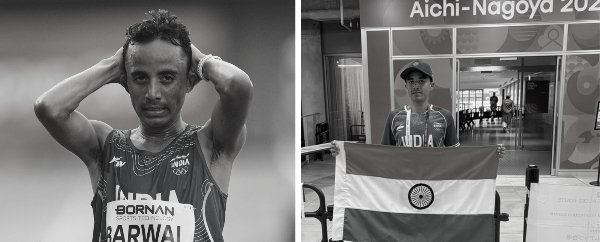
Nagoya: Indian Army athlete Sawan Barwal ended a 44-year wait for an Asian Games marathon medal on Saturday, winning silver in the men’s event at Nagoya with a national-record time of 2:11:37. The 28-year-old finished behind Japan’s Ichitaka Yamashita, who won gold in 2:10:49, while China’s Peiyou Feng took bronze in 2:12:13.
Barwal’s result takes Indian men’s marathon running back to the Asian Games podium for the first time since the 1982 Delhi edition, when Hosur Kukkappa Seetharan won bronze. India’s earlier marathon medals included Chhota Singh’s gold and Surat Singh Mathur’s bronze at the inaugural Asian Games in 1951. Barwal’s silver is therefore not simply another athletics medal; it closes one of the longest gaps in India’s Asian Games record.
The race itself was built around consistency rather than a late surge. Barwal was among the leading runners early and reached the halfway point in 1:05:54. He remained second through the 35-kilometre mark and held that position during the closing stages as Yamashita gradually created a gap. Barwal completed the 42.195-kilometre course in 2:11:37, improving his own national record in the process.
The performance is particularly notable because Barwal only switched to marathon running earlier this year. Until then, the Army athlete had competed mainly in track events. His transition produced a major breakthrough in April, when he broke Shivnath Singh’s 48-year-old national marathon record at the NN Marathon Rotterdam. Saturday’s run in Nagoya lowered the national mark again.
The shift from track racing to the marathon is not a minor change for an athlete. The event demands a different approach to pacing, endurance, recovery and preparation, with performance often decided over the final stretch rather than in a short burst of speed. Barwal’s progression this year has therefore given Indian athletics a new reference point in a discipline where the country has not consistently produced Asian-level podium finishes.
His medal also comes at a time when Indian athletics has been trying to widen its international presence beyond a handful of established events. Track and field success at major competitions is often concentrated in disciplines such as javelin, while distance running requires a deeper pipeline of athletes capable of maintaining international pace over long distances. Barwal’s national-record progression provides one indication of what sustained development in the event can produce.
His own assessment after the race was equally direct. Speaking after the silver, Barwal said the medal validated the decision to move into marathon running and that without a medal, the shift would have felt like wasted time. His remarks underline how quickly the change in event has translated into a major international result.
There was another Indian in the field, with Kartik Karkera finishing 17th among the 19 competitors in 2:22:41. The gap between the two Indian performances also shows the depth still required if India is to turn an individual breakthrough into sustained strength in the event.
For Barwal, however, the immediate record is clear. He has become the first Indian man in 44 years to win an Asian Games marathon medal and has done so while setting a new national record. The silver in Nagoya is India’s fourth Asian Games medal in the men’s marathon, following the medals won in 1951 and 1982.
