
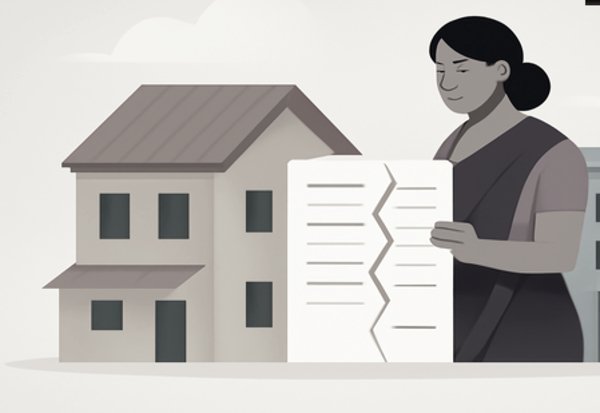
A large housing announcement in West Bengal has put an old question back into the spotlight: when a government house is registered in a woman’s name, how much does that change her economic security inside the family?
The state government has announced that more than 50 lakh newly constructed houses under government housing schemes will be registered in women’s names, while around 1.58 crore women are being credited with a ₹3,000 monthly instalment under the Annapurna scheme. The announcements were made on September 17 as the state marked Annapurna Diwas.
The numbers are large.
But the more important issue is what ownership actually means once the ceremony, paperwork and payment transfer are over.
Why does a woman’s name on a house matter?
A house is not simply a roof.
For a household with limited assets, ownership can influence where a family lives, who has a legal claim to the property and what happens if the family relationship changes.
Putting a woman’s name on a housing document can therefore give her a formal connection to an asset that may have significant financial value.
But the legal strength of that ownership depends on the documents.
A woman’s name appearing on a housing record is meaningful only if the underlying title, allotment and registration documents establish her legal rights in the property. The exact nature of those rights can vary depending on the housing scheme and the legal form of the allotment.
That is why “house in a woman’s name” should not automatically be treated as identical to full private property ownership.
What has West Bengal announced?
The state has announced that women will be made legal owners of more than 50 lakh newly provided houses under government housing programmes. The announcement was made alongside the release of the latest Annapurna scheme instalment.
The Annapurna scheme provides eligible women with monthly financial assistance. On September 17, the state announced the transfer of ₹3,000 to around 1.58 crore women through direct benefit transfer.
These are separate measures.
One concerns housing ownership.
The other is a recurring cash benefit.
Combining them under a single “women’s welfare” label would miss an important difference between an income-support payment and ownership of an asset.
Does property ownership improve financial security?
It can.
An asset in a woman’s name may provide a stronger formal position within the household than simply being a resident of a house owned by someone else.
Property ownership can also matter when families deal with inheritance, succession, housing security or financial planning.
But ownership alone does not resolve every problem.
A woman may have a property document and still have limited control over household finances. She may not have independent income, access to legal advice or the ability to make decisions about the property without family pressure.
That means the impact of ownership depends partly on whether women understand the documents they receive and can exercise the rights those documents provide.
Why are the documents so important?
Government housing programmes involve different categories of land and property arrangements.
A beneficiary may receive an allotment, a house constructed under a government scheme or another form of recognised housing right. The exact legal position depends on the relevant programme and documentation.
This is where headlines can become misleading.
Saying that millions of women are becoming “homeowners” can suggest that every beneficiary receives unrestricted private property that can be sold, transferred or mortgaged like any other privately purchased house.
That cannot be assumed without checking the applicable scheme rules and title documents.
The actual document is what establishes the legal position.
What about the ₹3,000 Annapurna payment?
The Annapurna scheme is different because the benefit is a direct financial transfer.
Reports on the September instalment say around 1.58 crore eligible women are receiving ₹3,000 through their linked bank accounts. Eligibility rules apply, including age and other conditions, and government information has previously indicated that some accounts faced documentation or banking problems.
Direct transfers can give women access to money in their own bank accounts.
That can be significant in households where women have limited independent income.
But a monthly benefit and an owned asset serve different purposes.
A cash transfer can help with recurring expenses. A house is a long-term asset.
The two should therefore be evaluated separately.
What should women receiving a government house check?
A beneficiary should not rely only on a verbal assurance that the property is “in her name.”
The paperwork should be understood.
Useful checks include:
Name on the allotment document
Name on ownership records
Nature of the property right
Whether joint ownership applies
Transfer restrictions
Inheritance provisions
Relevant scheme conditions
Local registration requirements
If the documents are unclear, beneficiaries may need assistance from the relevant local authority or qualified legal professional.
The point is not to create unnecessary paperwork.
It is to make sure that the person whose name appears in the scheme actually understands the right attached to that name.
Can women’s ownership change family decision-making?
There is no automatic guarantee.
Ownership can strengthen a woman’s formal position, but its practical effect depends on how the household handles property, income and decisions.
A woman who owns an asset may have greater security than someone with no recognised property interest. Yet social and economic circumstances can still determine whether she exercises that right independently.
That is why the implementation of a housing policy matters as much as the headline number of houses allocated.
The next stage is not simply construction.
It is documentation, registration, awareness and the ability of beneficiaries to use their legal rights.
What happens now?
The West Bengal government has announced the transfer of the September Annapurna instalment to eligible beneficiaries and the registration of new government houses in women’s names.
The practical measure of the housing announcement will emerge through the documents issued to beneficiaries and the rights those documents provide.
For the women receiving the houses, that paperwork will determine the legal meaning of the government’s announcement.
