
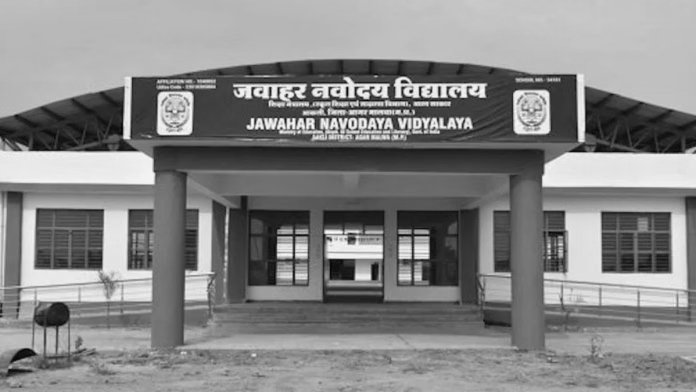
The Supreme Court has given the Tamil Nadu government another three months to comply with its earlier direction to identify land in every district for Jawahar Navodaya Vidyalayas, while urging the Centre and the state to continue discussions over the implementation of the schools.
The hearing has brought together three separate issues – access to centrally run residential schools, the language used in their curriculum and the financial responsibilities involved in establishing them. The Court has not accepted Tamil Nadu’s request to withdraw its earlier direction, and the state has raised objections connected to language policy and implementation costs.
The dispute therefore cannot be reduced to a simple argument over whether schools should exist.
It involves questions of access, language and the division of responsibilities between the Union and a state government.
What are Jawahar Navodaya Vidyalayas?
Jawahar Navodaya Vidyalayas are centrally supported residential schools intended primarily for students from rural areas.
They are administered through the Navodaya Vidyalaya Samiti under the Union Ministry of Education. Admission is through a selection process, and the schools are designed to provide residential education from the middle-school level onward.
The government’s position is that establishing schools across districts expands access to this model of education.
Tamil Nadu, however, has raised concerns about the conditions attached to the establishment of the schools, including the language component and the financial implications for the state.
What has the Supreme Court directed?
The Court had earlier directed Tamil Nadu to identify land in every district for setting up Navodaya Vidyalayas.
The state has not completed that process within the earlier timeframe, leading to further proceedings.
On September 17, the Court gave the state another three months to comply while also encouraging continued discussions between the Centre and Tamil Nadu.
That means the immediate legal position is clear: the earlier direction remains in place.
The additional three months provide more time for implementation.
Why is language at the centre of the dispute?
Language is one of the main objections raised by Tamil Nadu.
The state has long followed a two-language policy in school education and has opposed the implementation of a three-language structure associated with the National Education Policy.
Navodaya schools follow a curriculum in which students are taught multiple languages.
During the hearing, the Supreme Court indicated that Hindi could not simply be excluded from the schooling model under consideration. At the same time, the Court encouraged the Centre and state to resolve their differences through dialogue.
The issue is sensitive because language education has a long political and social history in Tamil Nadu.
But the current legal question is narrower: whether the state can decline to provide land for a centrally administered school model because it disagrees with aspects of its language policy.
The Court is addressing the implementation of its earlier direction rather than deciding the entire national debate over language education.
What does this mean for students?
For students and families, the most direct issue is access.
If Navodaya schools are established in more districts, students who meet the admission requirements would have another residential schooling option. These schools are particularly intended to serve rural students, making their availability a potential education opportunity for families outside major urban centres.
But establishing a school on paper does not create an immediate classroom.
Land must be identified, facilities developed, staff appointed and admissions conducted.
There is therefore a substantial administrative process between the Court’s direction and a student actually entering a Navodaya campus.
That process is now back on a three-month clock for Tamil Nadu’s land-identification requirement.
What about the financial issue?
Tamil Nadu has also raised questions concerning the financial responsibilities associated with the schools.
Education in India involves responsibilities distributed across different levels of government, and centrally administered schemes can involve questions about land, infrastructure and other local requirements.
The financial disagreement therefore forms part of the larger implementation issue.
The Court’s direction does not remove the need for governments to work out the practical arrangements.
That is why the Court’s emphasis on continued dialogue matters.
Is this a Centre versus state issue?
The proceedings certainly involve a disagreement between the Union government and Tamil Nadu.
But describing the matter only as a political confrontation leaves out the people affected by the outcome.
The immediate beneficiaries, if the schools are established, would be students seeking access to residential education.
At the same time, Tamil Nadu’s objections about language and implementation costs are part of the state’s stated position and cannot simply be ignored.
The Court’s approach, as reported from the hearing, has been to retain its earlier direction while allowing additional time for compliance and encouraging discussions between the two governments.
That leaves both sides with responsibilities.
The state has to address the Court’s direction.
The Centre has to engage with the state’s concerns about implementation.
And the eventual outcome has to work within the legal framework governing centrally administered education.
What happens next?
Tamil Nadu now has three additional months to identify land in every district in accordance with the Court’s earlier order.
During that period, discussions between the Centre and state are expected to continue.
The next stage will therefore be measured less by statements and more by whether the required land is identified and whether the two sides can resolve the outstanding implementation issues.
For students and parents, the practical question will be when the legal direction translates into actual schools and admissions.
For now, the Supreme Court’s three-month extension is the immediate timeline.
RIAAN.TV | HAQ KI BAAT
