
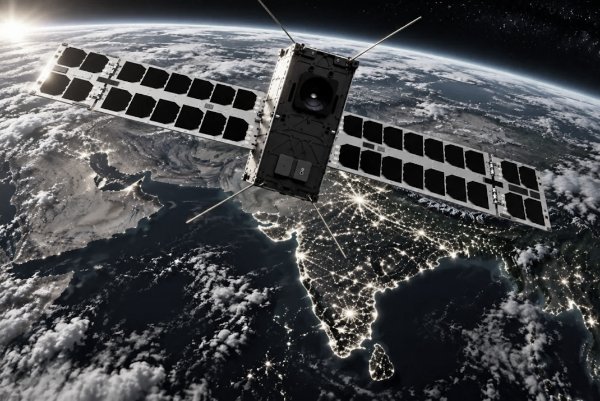
Hyderabad: India has moved another step into the emerging field of space-based computing with the launch of MOI-1A, an orbital-computing satellite developed by Hyderabad-based space technology startup TakeMe2Space, aboard SpaceX’s Transporter-18 rideshare mission on October 1. Unlike conventional Earth-observation satellites that send large volumes of raw data to ground stations for processing, MOI-1A is designed to analyse selected data in orbit and transmit the results back to Earth.
The satellite, weighing less than 50 kg, carries Nvidia Orin NX edge-computing processors and is intended to test how artificial intelligence can be used directly in orbit. The basic idea is straightforward: instead of transmitting every image or piece of information captured by a satellite, the onboard computer can examine the data, identify what is relevant and send only the required information to users on Earth.
That change could become important as the volume of satellite data grows. Earth-observation spacecraft can generate large datasets covering agriculture, mining, infrastructure, insurance and other areas. Sending all of that information to Earth requires communication bandwidth and processing capacity. TakeMe2Space says its approach is intended to reduce the amount of data that needs to be transmitted while making useful information available faster.
TakeMe2Space has said that 23 customers have signed up for the MOI-1A mission, including organisations working in agriculture, mining, supply chains and insurance. The company plans to allow customers to run selected artificial-intelligence models on the satellite and receive analysed information rather than the complete raw dataset.
For agriculture, such a system could eventually help identify changes in crops or land conditions from satellite imagery. In mining, it could assist with analysing terrain and identifying relevant patterns. Insurance companies could potentially use processed Earth-observation information for applications such as assessing changes to land or infrastructure. These are potential applications of the technology; the current mission is primarily a demonstration and validation of orbital computing.
The October 1 mission also comes after setbacks for the startup. TakeMe2Space’s earlier MOI-1 satellite was lost in the PSLV-C62 launch failure in January 2026. The company subsequently continued work on the next spacecraft and had already demonstrated aspects of its orbital-computing technology through an earlier mission.
The significance of MOI-1A therefore goes beyond putting another small satellite into orbit. It is part of a wider shift in which computing is moving closer to where data is generated. Instead of treating satellites mainly as instruments that collect information and send it down, companies are exploring whether spacecraft can also become computing platforms.
TakeMe2Space is already looking beyond the current mission. The company has outlined plans for a larger network of satellites capable of providing orbital computing services, with a longer-term objective of building an orbital data-centre network. Its own roadmap says the first node of a planned constellation is MOI-1A, with additional satellites intended to provide broader coverage.
For India’s private space sector, the mission is also significant because it demonstrates how domestic startups are beginning to work on specialised technologies rather than only supplying components or services to traditional space programmes. Hyderabad, which has a long association with India’s space and defence ecosystem, is becoming part of this new private-sector activity.
The immediate task for MOI-1A is to prove that the technology can perform reliably in orbit. If the system works as intended, future missions could process increasingly complex Earth-observation information before it reaches ground stations, reducing transmission requirements and shortening the time between data collection and useful analysis.
