
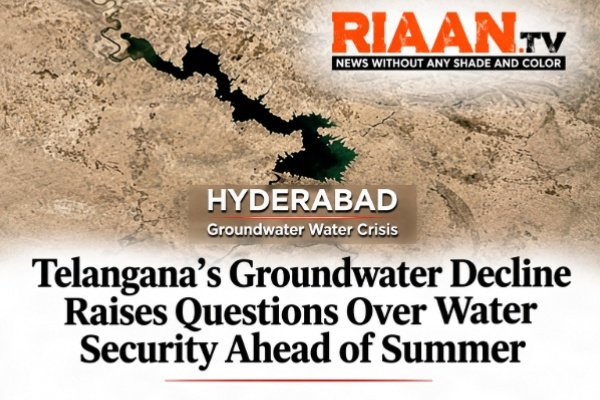
Hyderabad: Groundwater levels declined in 554 of Telangana’s 621 mandals during October, with the State recording an average water level of 8.28 metres below ground level, according to the latest assessment of the Telangana Ground Water Department. The findings, following a monsoon that delivered 24 per cent less rainfall than normal, have raised concerns over the availability of water for agriculture and domestic use as the State moves towards the summer months.
The October assessment recorded an average groundwater depth of 8.28 metres, compared with 7.52 metres in September. The department’s monitoring network covers all mandals across the State’s 33 districts through 1,771 piezometers. The October readings also show a substantial deterioration over the previous year, when the average stood at 4.42 metres below ground level.
The rainfall figures provide an important part of the explanation. Telangana received 628 mm of rainfall between June 1 and October 31, against the normal 831 mm, representing a deficit of 24 per cent. Only 11 of the State’s 33 districts received normal rainfall, while the remaining 22 recorded a shortfall.
The pressure is particularly visible in districts surrounding Hyderabad. Vikarabad recorded the deepest district-level average groundwater depth at 13.54 metres, followed by Sangareddy at 12.93 metres, Rangareddy at 12.75 metres and Medchal-Malkajgiri at 12.67 metres. Hyderabad district recorded an average depth of 11.10 metres. These figures indicate that groundwater is considerably deeper in several parts of the metropolitan region and its expanding periphery.
The distinction between Hyderabad district and the wider metropolitan region is important. The October assessment for Greater Hyderabad, covering the urban and surrounding municipal areas, recorded an average groundwater depth of 12.59 metres, compared with 5.42 metres in October 2025. The year-on-year decline of 7.17 metres points to the scale of pressure on underground water resources across the urban belt.
The consequences extend beyond individual borewells. Groundwater supports domestic consumption, commercial establishments and irrigation, particularly in areas where access to surface-water sources is limited. When rainfall replenishment falls short and extraction continues, households and farmers may face greater difficulty in accessing water, while the cost of obtaining it can increase.
The agricultural implications are also significant as farmers prepare for the Yasangi season. Agriculture and horticulture officials have advised farmers to consider crops requiring less water and avoid paddy cultivation in areas facing groundwater stress. Such decisions will depend on local water availability, irrigation access and the suitability of alternative crops.
The distribution of groundwater levels across the State shows that the problem is not uniform. Jagtial recorded the shallowest district average at 4.21 metres, followed by Khammam at 4.34 metres, Mahabubabad at 4.48 metres and Mancherial at 4.76 metres. At the other end, ten districts recorded average depths exceeding 10 metres, indicating considerable differences in groundwater conditions across Telangana.
The figures also underline the importance of protecting tanks, lakes and other local water bodies, alongside rainwater harvesting and groundwater recharge measures. Urban expansion and rising demand place additional pressure on these resources, making the maintenance of natural recharge systems an important part of long-term water planning.
The October assessment offers an early indication of the challenges that may emerge during the coming summer. The extent of the pressure will depend on subsequent rainfall, groundwater extraction and the effectiveness of conservation and supply measures. For Telangana, the task is not limited to meeting immediate water demand but also ensuring that groundwater reserves are not depleted faster than they can be replenished.
