
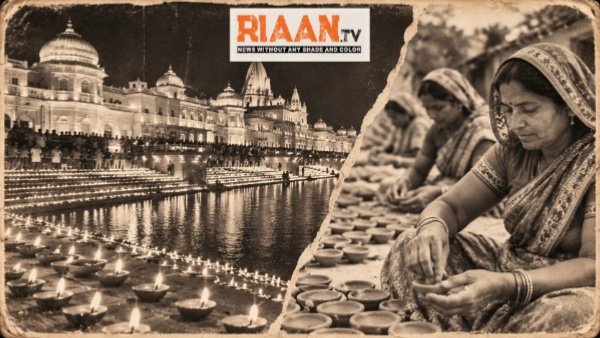
There are celebrations that are remembered for their scale, and there are those that stay with us because of what they represent. Ayodhya’s Deepotsav belongs to both. As millions of earthen lamps illuminate the banks of the Saryu, the city becomes the setting for a celebration that draws upon faith, memory, tradition and the cultural imagination associated with Lord Ram’s return to Ayodhya.
The tenth edition of Deepotsav on November 7 once again brought the city into national focus. The celebrations included the lighting of diyas, the Saryu Aarti, Ramayana-based performances, a symbolic coronation ceremony of Lord Ram and a drone presentation depicting episodes from the epic. The scale is striking, but I believe the more meaningful story lies beyond the spectacle.
Ayodhya has always occupied a special place in India’s cultural consciousness. Its significance is not limited to a temple, a festival or a particular occasion. It is a city associated with stories passed down through generations, where faith and cultural memory continue to shape everyday life. Deepotsav gives that inherited memory a public expression, bringing people together through rituals, music, performance and the simple act of lighting a lamp.
What makes this year’s celebrations particularly worth examining is the connection between a large cultural event and the people whose traditional skills help make it possible.
Among the preparations were orders placed with rural women potters for the production of earthen lamps. Twenty-five women potters from villages in Ayodhya and neighbouring Barabanki were engaged to supply 1.60 lakh diyas. The arrangement provided a market for their work and brought traditional pottery into an event of considerable public visibility.
This is an aspect of cultural celebrations that deserves greater attention. We often count the number of lamps, visitors, performances and records associated with a festival. We speak less about the hands that make those celebrations possible. Behind every earthen diya is a craftsperson, a family and a livelihood sustained through a skill that has travelled across generations.
For traditional artisans, access to larger markets can make a tangible difference. An event of this scale can create opportunities for potters, flower sellers, local traders, transport workers, performers and small businesses. However, the real measure of its economic contribution should be whether these opportunities continue beyond the festival and reach communities that are often distant from the main centres of tourism.
There is another dimension to Deepotsav that I find significant: the meeting of tradition and contemporary expression. Ramleela performances, folk arts and the lighting of earthen lamps remain central to the celebrations, while technology, including large-scale drone displays, introduces newer ways of presenting familiar stories. Tradition does not necessarily have to remain frozen in time. It can find new forms of expression while retaining the meaning that gives it continuity.
Yet, the responsibility that accompanies an event of this scale should not be overlooked. Cultural tourism requires careful planning, public safety, accessible facilities, sanitation and respect for the city’s residents. The benefits of a growing festival should be visible not only in the photographs of illuminated ghats but also in the everyday lives of the people who live and work in Ayodhya.
I have always believed that the strength of a cultural celebration is not determined only by the grandeur of its arrangements. Its deeper value lies in the people it brings together, the traditions it sustains and the opportunities it creates for those who might otherwise remain outside the spotlight.
The image of millions of lamps along the Saryu is undoubtedly powerful. But there is another image worth remembering: a rural woman shaping clay into a diya, a performer keeping an old art form alive, a family preparing for visitors and a craftsperson finding a larger market for a traditional skill.
Perhaps that is where the enduring meaning of Deepotsav lies. The lamps illuminate Ayodhya for an evening, but the traditions, skills and livelihoods behind them deserve recognition throughout the year.
A festival becomes part of a living heritage when its light reaches beyond the place where it is celebrated and touches the lives of the people who keep its traditions alive.
