
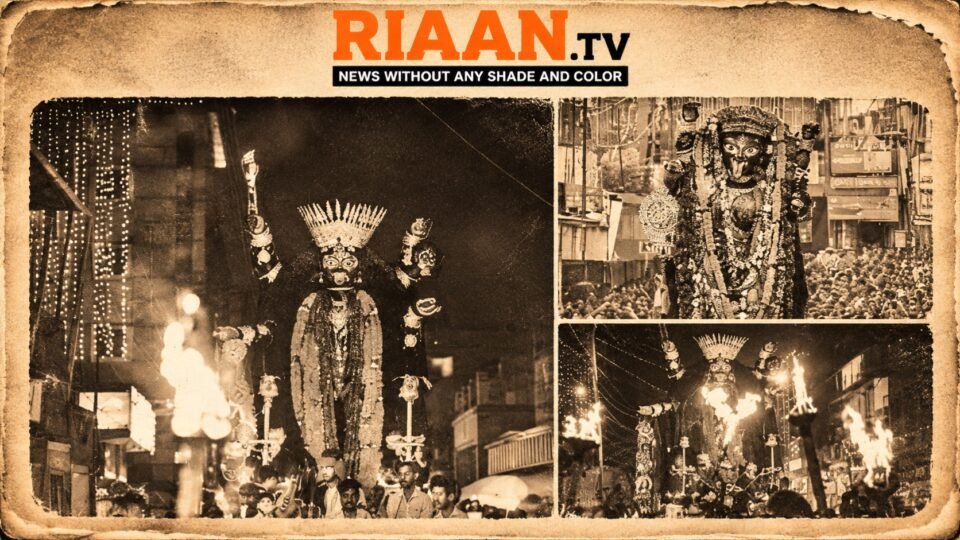
Shantipur: As the lights dim and the sound of dhaks fills the night, a towering image of Goddess Kali begins to sway above a crowd of devotees. Carried on a bamboo structure by a group of men, the idol moves rhythmically through the streets, creating the striking impression that the goddess herself is dancing. This is the distinctive immersion procession of Shantipur’s Bama Kali in Nadia district, a local religious tradition that has drawn growing attention well beyond Bengal.
The procession took place on November 9, a day after Kali Puja. This year, however, it unfolded in a different setting. For the first time in 56 years, the celebrated dance was shifted from its traditional location near Barabazar crossing to Bejpara ground. The change followed concerns over crowd management during the previous year’s event and discussions between the organisers and local authorities. The immersion continued at the traditional Barabazar ghat.
A tradition rooted in a local account
The history of the present Shantipur Bama Kali worship is traced by organisers and local accounts to 1969. According to the story recounted in Bengali media, a 14-year-old girl named Yamuna Chowdhury experienced what devotees describe as a divine manifestation during the immersion of the area’s older Bombat Kali. She is said to have conveyed the goddess’s wish to be worshipped in the locality.
The first worship reportedly took place through the installation of a sacred pot, or ghat. An idol was introduced the following year, in 1970. The deity was initially associated with Yamuna and came to be known as Bama Kali. The name is linked to the form of the goddess in which her left foot rests on Shiva’s chest.
These details belong to the tradition’s local religious account and should be understood as beliefs preserved by devotees, rather than independently established historical events. The distinction matters because exaggerated claims about the age of the present puja have circulated on social media. Organisers have publicly stated that the current worship is entering its 58th year, not that this particular puja is several centuries old.
There is also a wider historical connection. Shantipur has an older Bombat Kali tradition, and the relationship between that worship and the later Bama Kali is part of the local account of how the present puja emerged. The two should not be casually treated as one and the same institution.
Why does the goddess appear to dance?
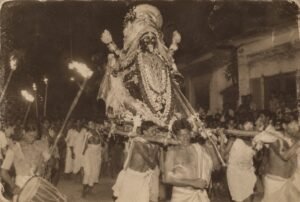
The most recognisable part of the celebration is the procession after worship. The idol is placed on a bamboo carrying frame, traditionally known as a sanga, and lifted by devotees. As the bearers move together to the rhythm of the drums, the large image sways from side to side. The coordinated movement gives the procession its distinctive appearance.
The ritual is also shaped by accounts of instructions attributed to the goddess through Yamuna Chowdhury. Local tradition holds that the goddess wanted to go through the town after worship and meet certain other deities regarded as her companions. The dancing is associated with the joy of these encounters. These beliefs guide the route and practices followed by the organisers.
Another striking feature is the use of limited lighting. The puja is traditionally conducted with candles, lamps and lanterns rather than bright electric illumination. During the procession, torches and traditional lights create a dramatic contrast between the moving idol and the surrounding darkness. Accounts of the practice link it both to instructions attributed to the goddess and to the older days when processions depended on torchlight.
Around the idol, the bearers’ coordinated movements, the beat of the dhak and the participation of devotees turn the immersion journey into a collective ritual rather than a conventional procession.
When popularity changes the way a tradition is observed
In recent years, videos of the Bama Kali dance have travelled widely on social media. The images have brought the Shantipur tradition to audiences who may never have visited the town. That visibility has also increased the pressure on organisers to accommodate large crowds in a relatively confined area.
The shift to Bejpara ground this year was a practical response to those concerns. Organisers and local reports pointed to difficulties managing spectators and movement around the old venue. The larger ground was selected to provide more space for the event and improve crowd arrangements. The change did not alter the traditional immersion destination.
The decision illustrates a challenge faced by many community festivals: how to preserve a ritual’s character while responding to the scale of public attention it now attracts. A larger venue can create room for spectators, but safety also depends on controlled entry and exit, clear routes, medical assistance, emergency access and coordination between volunteers and police.
A living tradition, not just a viral spectacle
Shantipur’s Bama Kali procession is often encountered online through dramatic images of a dancing idol. Yet its meaning for the community lies in a longer sequence of worship, local belief, ritual instructions and collective participation. The people who carry the idol, organise the puja and preserve its customs are central to the tradition.
The change of venue in 2026 shows that traditions do not always survive by keeping every external detail unchanged. Their continuity can also depend on adapting the arrangements around them while retaining the practices that give them meaning.
For Shantipur, the challenge will be to protect the intimacy and discipline of a community ritual even as wider public attention grows. The goddess may now dance before a much larger audience, but the story behind that movement remains rooted in the town’s own memory and faith.
