
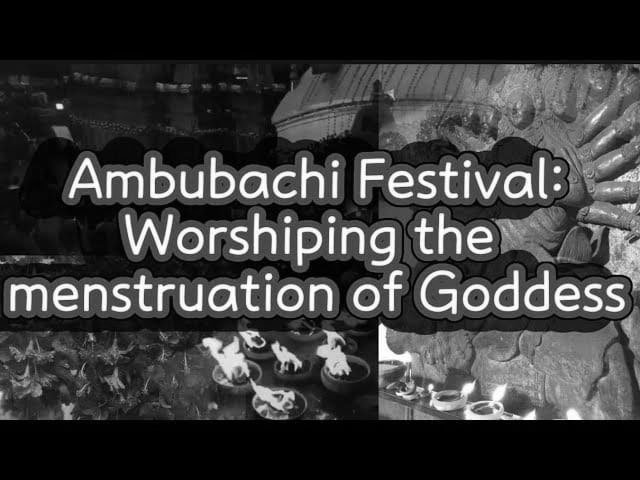
At the Kamakhya Temple in Guwahati, one of India’s most unusual religious traditions unfolds every year.
The Ambubachi Festival is associated with the annual menstruation of Goddess Kamakhya, a manifestation of Shakti, or feminine divine power. For devotees, the phenomenon is not regarded as something impure or hidden. It is a sacred expression of fertility, creation and the power of the feminine.
The temple traditionally remains closed for three days during the festival. Devotees gather around the temple complex, waiting for the doors to reopen and for the sacred rituals to resume.
RIAAN.TV’s earlier ground report captures the atmosphere surrounding the festival – the offerings, rituals, devotees, ascetics and the stream of pilgrims arriving at Kamakhya.
But Ambubachi is more than a large religious gathering.
A DIFFERENT UNDERSTANDING OF MENSTRUATION
Menstruation has traditionally been surrounded by silence, restrictions and social taboos in many parts of Indian society.
Ambubachi presents a strikingly different religious idea.
Here, the menstrual cycle of the Goddess is associated with divine power and fertility.
The festival is therefore often seen as a celebration of the feminine principle and the natural cycle of creation.
This contrast is one of the reasons Ambubachi continues to attract attention beyond the religious sphere.
THE KAMAKHYA TRADITION
Kamakhya is one of the most important Shakti pilgrimage centres in India and is closely associated with Tantric traditions.
Unlike many temples where the principal deity is represented through a conventional idol, the sanctum at Kamakhya is associated with a naturally formed stone symbol representing the feminine creative principle.
During Ambubachi, this symbolism takes on particular importance.
The rituals, offerings and practices surrounding the festival are rooted in a long religious tradition in which fertility, womanhood and the power of creation occupy a central place.
WHEN THE TEMPLE CLOSES
The closing of the temple is one of the defining moments of Ambubachi.
For three days, devotees wait outside while the temple remains closed.
The period is traditionally associated with the Goddess undergoing her menstrual cycle.
When the temple reopens, devotees return for darshan and seek blessings.
Sacred offerings associated with the festival are also distributed to devotees, who attach deep spiritual significance to them.
A GATHERING OF MANY WORLDS
The festival brings together very different groups of people.
Devotees arrive from different parts of India.
Ascetics and practitioners associated with Tantric traditions gather at the temple.
Local residents live alongside the annual influx of pilgrims.
For Guwahati, the festival is also a major public event requiring arrangements for crowds, security, sanitation, transport and accommodation.
The visual atmosphere captured by RIAAN.TV reflects this diversity – religious rituals taking place alongside large crowds of ordinary pilgrims and visitors.
BEYOND THE SPECTACLE
Ambubachi is often described simply as a festival connected with the menstruation of a Goddess.
But that description only tells one part of the story.
At its heart is an older idea: that creation itself is sacred, and that feminine reproductive power is not separate from divinity.
The festival also raises a question that remains relevant in contemporary India:
Why can menstruation be treated as sacred in a religious tradition while ordinary women can still face stigma and silence around the same biological process?
The answer is neither simple nor uniform.
For devotees, Ambubachi is primarily an expression of faith.
For scholars, it offers an important window into India’s Shakti and Tantric traditions.
For women and social observers, it presents a striking cultural contrast in the way menstruation can be understood.
And for Assam, it remains one of the region’s most significant religious and cultural gatherings.
THE RIAAN ARCHIVE
Years after this RIAAN.TV ground report was filmed, the images remain relevant because the questions surrounding Ambubachi have not disappeared.
The crowds change.
The technology changes.
The way people talk about menstruation changes.
But the central belief remains deeply rooted in the Kamakhya tradition:
the feminine power of creation is worthy of worship.
Watch the original RIAAN.TV ground report above.
RIAAN.TV Deep File | Archive
The Story Behind the Story.
