
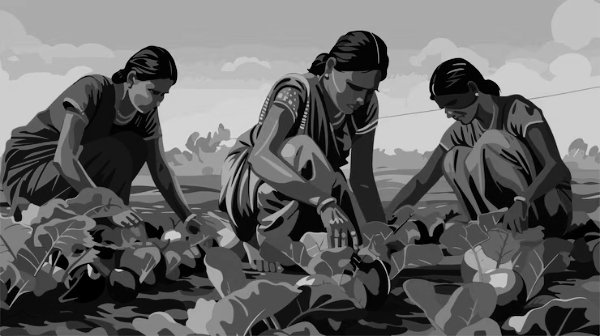
New Delhi: Women are deeply involved in Indian agriculture, from sowing and harvesting to livestock care, processing and marketing, yet their formal position as farmers continues to be closely tied to land and asset ownership. The issue came into focus again at a national conference of women farmers in Delhi, where participants and speakers called for greater recognition of women as farmers and agricultural entrepreneurs rather than treating them primarily as agricultural labourers or family helpers.
The gap between work and formal recognition is visible in government data.
The Agriculture Census 2015-16 recorded women as operating about 13.9 per cent of agricultural holdings in India. Earlier Agriculture Census data showed the share rising from 11.7 per cent in 2005-06 to 12.8 per cent in 2010-11 and 13.9 per cent in 2015-16.
The figure is about operational holdings, not every woman who works on a farm.
That distinction matters.
A woman may spend much of the agricultural season working on family land but not be the person recorded as the operational holder. She may sow, transplant, weed, harvest, look after livestock, preserve seeds or handle post-harvest work while land records remain in another family member’s name.
The result is a gap between participation in agriculture and control over agricultural assets.
The government’s own 2026 backgrounder on women farmers notes that women are involved across the agricultural value chain and says 80 per cent of rural women are engaged in agriculture and allied sectors, with 33 per cent described as agricultural labourers and 48 per cent as self-employed farmers.
The numbers come from the government’s compilation of available data and should not be confused with the Agriculture Census measure of women-operated land holdings. They measure different aspects of women’s participation in agriculture.
What they collectively show is that women’s role in farming is considerably wider than the number of land holdings formally operated by women.
Land changes the equation
Land ownership and operational control have consequences beyond the title document.
Agricultural land can influence access to institutional credit, government schemes, crop insurance, irrigation facilities and other agricultural services. The ICAR Gender Strategy released in 2025 identified women’s access to land, agricultural inputs, services, credit and technology as continuing areas of disadvantage and linked those gaps to their limited participation in decision-making.
The land gap is visible beyond agriculture-specific records as well.
According to NFHS-5 data cited by the Ministry of Women and Child Development in 2026, 31.7 per cent of women aged 15-49 owned land alone or jointly, compared with 42.3 per cent of men in the same age group. The figures cover land ownership generally and are not limited to agricultural land.
For a woman farmer, the absence of land in her name can therefore become a practical barrier.
It can affect whether she is recognised as the person taking decisions on the farm, whether she can approach an institution independently for credit and how easily she can access programmes designed around the farmer as an individual.
Recognition is changing, but slowly
There are signs of a shift.
The Centre’s 10,000 Farmer Producer Organisation programme had, as of March 1, 2026, 1,175 FPOs with 100 per cent women membership, while 23.55 lakh women farmers were registered across the scheme.
The government has also reported that women constitute about 40 per cent of shareholders across the FPOs formed under the central scheme, with at least one woman member mandated on the governing body of each FPO.
Such collectives can change the relationship between an individual woman farmer and the market.
A woman working on a small holding may have limited bargaining power when buying inputs or selling produce. As part of an FPO, she can potentially participate in collective procurement, processing and marketing.
But membership alone does not resolve the underlying question of who owns or controls land.
The issue is not only about ownership
Women’s contribution to farming is often spread across tasks that do not appear in crop-production statistics.
Livestock management, seed preservation, food processing, storage, harvesting and post-harvest work can all be central to the farm economy. The government has acknowledged this wider role while expanding training, technology and collective initiatives for women farmers.
The challenge is converting participation into economic control.
A woman who works on a farm but cannot independently access credit, decide how income is used or control the land has a different economic position from a woman who operates the holding in her own name.
That difference becomes particularly important when agriculture is hit by drought, crop loss or debt.
Women may carry a large part of the unpaid and informal work required to keep a household and farm functioning, while formal financial decisions remain elsewhere in the family.
2026 puts the issue in focus
The United Nations has designated 2026 as the International Year of the Woman Farmer, bringing renewed attention to women’s contribution to agriculture. India is also expanding programmes involving women-led FPOs, agricultural training, technology and credit support.
The question now is whether policy recognition can move beyond programmes and reach the underlying structure of agricultural ownership and decision-making.
The answer will not be found simply in counting how many women work in fields.
It requires looking at whose name appears on the land record, who operates the holding, who receives institutional credit, who controls the income, who can access government schemes and who makes the decisions when a crop fails.
India’s women are already doing a substantial share of the work that keeps agriculture running.
The harder question is whether the systems around farming recognise them with the same clarity.
