
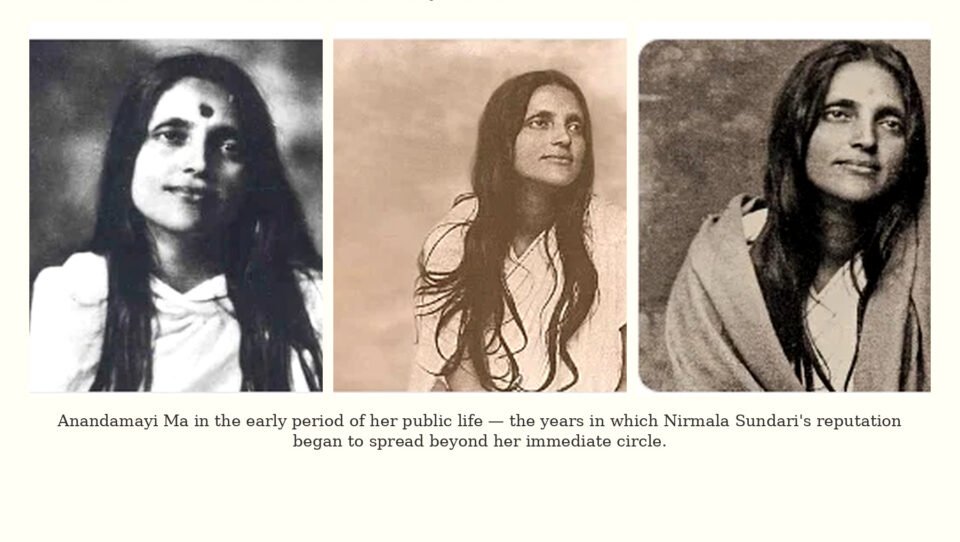
RIAAN.TV Deep File Beyond the Legend
THE FINAL QUESTION
So what should we finally call Anandamayi Ma?
A saint?
A mystic?
A guru?
A religious genius?
A woman who became the centre of an extraordinary devotional movement?
A figure whose followers genuinely encountered something they could not explain?
Or, for those who believe it:
the Divine Mother who took human form?
There is no shortage of answers.
But before choosing one, there is another question worth asking:
What do we actually know?
That takes us back to a village in present-day Bangladesh.
—
BEFORE THERE WAS ANANDAMAYI MA
In Kheora, in what is now Brahmanbaria, Bangladesh, a girl named Nirmala Sundari was born on 30 April 1896.
Her father, Bipinbehari Bhattacharya, was a deeply religious man. Her mother was Mokshada Sundari.
Nirmala grew up in a Hindu family in a village where Muslims formed a large part of the local population.
The later stories about her childhood are full of extraordinary incidents. Some say she would become absorbed in kirtan. Others describe unusual spiritual experiences.
But here the record becomes less certain.
Most of these stories come to us through family recollections and devotional accounts preserved much later.
What we can say with confidence is simpler.
She was born in Kheora. She grew up there and in nearby areas. Her formal education was limited.
And at a very young age, she was married.
THE CHILD BRIDE
Her husband was Ramani Mohan Chakravorty, later known as Bholanath.
The marriage took place when Nirmala was still a child.
For years, this was the life she lived – a young Bengali wife moving with her husband and living within the conventions of the time.
But something unusual was happening.
People around her began noticing her intense religious absorption.
At Astagram, she was reportedly called “Kushir Ma” – Mother of Bliss.
At Bajitpur, accounts began describing spontaneous yogic movements and spiritual states.
Then came 1922.
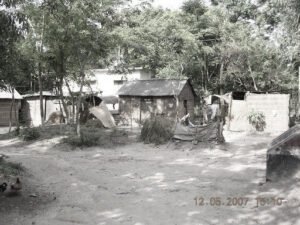
THE NIGHT OF 1922
This is where the story takes a dramatic turn.
According to the tradition preserved by her followers, Nirmala underwent self-diksha – initiation without an external guru.
The later accounts describe a remarkable process in which the usual roles of guru, disciple, mantra and deity were not separated in the ordinary way.
It is an extraordinary claim.
But the journalist’s question is not whether the story sounds extraordinary.
It is:
Who recorded it? And when?
The surviving account comes principally through the spiritual tradition surrounding Ma, including later recollections attributed to her own explanations.
That makes it an important historical testimony.
It does not give us an independently witnessed reconstruction of every detail.
That distinction matters.
Because from this point onward, the story of Nirmala Sundari begins to merge with the story of Anandamayi Ma.
DHAKA CHANGES EVERYTHING
In 1924, Nirmala and Bholanath moved to Dhaka.
Bholanath had been appointed caretaker of the Shahbag gardens.
There, something changed.
People began coming to see Nirmala.
Some came out of curiosity. Others came because they had heard about her spiritual state. Some came looking for answers, blessings or healing.
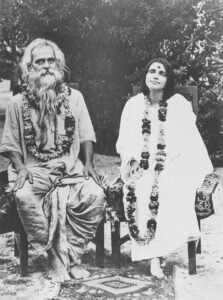
Among the people drawn to Shahbagh was Jyotish Chandra Ray, better known as Bhaiji.
He became one of her closest devotees.
He also became one of the people who helped preserve the early story.
In 1925, at Siddheshwari, Bhaiji gave her the name by which she would become famous:
Anandamayi.
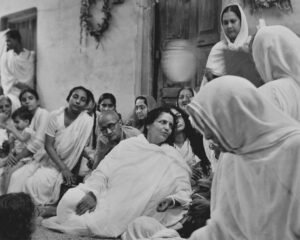
The Mother of Bliss.
Soon another important figure entered her life.
Gurupriya Devi became a close devotee and kept diaries that later became an important source for accounts of Ma’s early years.
There is something important here.
Bhaiji and Gurupriya were witnesses.
But they were also believers.
Their records are valuable precisely because they were close to her. At the same time, their devotion means their accounts cannot simply be treated as the equivalent of an independent reporter’s notebook.
That is not a criticism.
It is part of the evidence.
—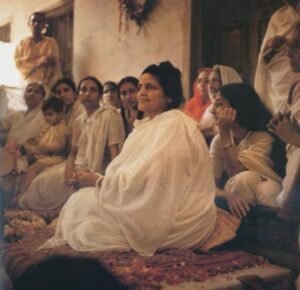 THEN THE STORIES BEGAN TO TRAVEL
One of the earliest examples is particularly revealing.
Gopinath Kaviraj, a respected scholar who later became closely associated with Ma, recalled that he first heard about her through a pamphlet describing a miraculous escape from a snakebite.
The story interested him enough to go and see her.
This tells us something important.
The miracle story was not merely part of Ma’s private circle.
It was becoming a way of spreading her reputation.
Other stories followed – including accounts of healing and extraordinary experiences.
Should we believe them?
That is not a question that can be answered by simply repeating the stories.
We have to ask who was there, when the account was written, whether there was independent corroboration and whether there is another possible explanation.
In some cases, the surviving record simply does not take us that far.
So the honest description is:
a miracle was reported.
Not:
a miracle was proved.
—
KHEORA’S OTHER MEMORY
There is another part of Ma’s story that deserves attention.
She was born into a Hindu family, but Kheora was not a purely Hindu village.
Accounts preserved by her followers describe Muslims in the village as being fond of the young Nirmala.
Years later, when devotees returned to Kheora, they recorded a striking response from local Muslims: Ma was not regarded as belonging only to the Hindus. She was described as “our Mother” too.
That memory is part of the Anandamayi tradition, and it should be treated as such.
But it tells us something worth noticing.
The image of Ma as a spiritual figure who crossed religious boundaries was not created only after she became famous.
It was connected, at least in the remembered history, to the place where her life began.
—
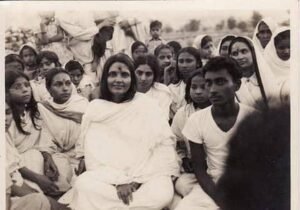
THE WOMAN BECOMES A PUBLIC FIGURE
By the 1930s, Anandamayi Ma was no longer simply a woman known to a circle in Dhaka.
She was travelling.
People were building ashrams around her.
Scholars and spiritual seekers were meeting her.
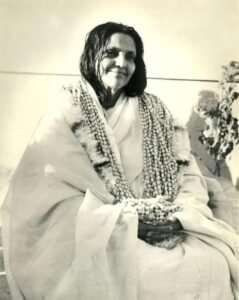
Her photographs were circulating.
Her words were being recorded.
And her reputation was growing far beyond Bengal.
Then came the West.
— YOGANANDA AND THE WORLD OUTSIDE INDIA
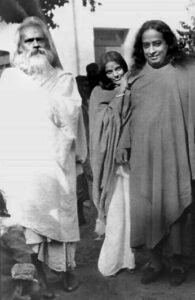
Paramahansa Yogananda introduced Anandamayi Ma to a huge international readership through Autobiography of a Yogi.
For many Western readers, this was their first encounter with her name.
Soon Western seekers began travelling to India to see her.
Among them was Colin Turnbull, the anthropologist.
Turnbull is an especially interesting case.
He came as an outsider, someone interested in understanding India and its religious traditions.
But he became deeply involved in Ma’s world.
The observer had become part of what he was observing.
That does not make his account useless.
It makes it more complicated – and, in some ways, more interesting.
—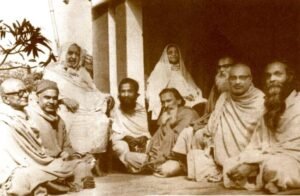
BY THEN, MA HAD BECOME MUCH MORE THAN A GURU
Her following continued to grow.
Ashrams developed.
Books appeared.
Devotees recorded their experiences.
Foreigners came.
Scholars came.
And eventually political leaders came.
Indira Gandhi met Anandamayi Ma several times during the final years of her life.
By then, Ma had acquired a public stature that went well beyond a small religious circle.
When she died in 1982, thousands gathered for her final rites.
The woman born Nirmala Sundari had become one of India’s best-known spiritual figures.
—
BUT THERE IS ANOTHER RECORD
For much of the early story, we depend heavily on people who knew Ma and believed in her.
For the later years, however, the evidence becomes richer.
Harvard Divinity School holds a substantial collection of Anandamayi’s papers covering 1950 to 1981.
There are photographs.
Films.
Videotapes.
Audiotapes.
Transcripts.
And recordings of question-and-answer sessions with her followers.
That matters.
Because now we are not relying only on somebody saying, years later, “Ma once said this.”
There are recordings of the woman herself.
We can hear her voice.
We can examine what she actually said in particular settings.
It does not prove that she was divine.
But it gives us something historians always want:
a record close to the person herself.
 —
—
WHAT, THEN, IS TRUE?
Some things are not seriously in doubt.
Nirmala Sundari was a real woman.
She was born in Kheora in 1896.
She married young.
She moved to Dhaka.
She attracted followers.
Bhaiji and Gurupriya became important early witnesses.
The name Anandamayi became attached to her.
Her reputation spread across India and eventually abroad.
She met scholars, spiritual seekers and political figures.
Her words and conversations were recorded.
Her followers built institutions that continue to preserve her memory.
Those are historical facts.
Then there are the other claims.
The self-diksha.
The miracles.
The healings.
The extraordinary spiritual states.
The belief that she was an incarnation of the Divine Mother.
These are not all the same kind of evidence.
Some come from direct witnesses.
Some from devotees.
Some from later biographies.
Some remain impossible to independently verify.
And that is where the line between history and faith becomes clear.
—
THE FINDING
After going through the record, one thing becomes difficult to deny…..
Anandamayi Ma was not simply created by a biography.
There was a real woman at the centre of it.
There were people who met her and recorded their experiences.
There were devotees who spent years with her.
There were photographs, diaries, letters and eventually recordings.
There were people who came away convinced that they had encountered something extraordinary.
At the same time, the supernatural explanations attached to many of those experiences cannot always be independently established.
Both things can be true.
The testimony deserves to be heard.
The evidence deserves to be tested.
And faith deserves neither ridicule nor automatic acceptance.
—
THE FINAL QUESTION
So what should we finally call Anandamayi Ma?
A saint?
A mystic?
A guru?
A religious genius?
A woman who became the centre of an extraordinary devotional movement?
A figure whose followers genuinely encountered something they could not explain?
Or, for those who believe it:
the Divine Mother who took human form?
A responsible Deep File does not have to choose a theological answer.
It has to tell the truth about the evidence.
And perhaps the most honest conclusion is this:
We can reconstruct how Anandamayi Ma became a legend.
We can document the people who believed in her.
We can trace the books, diaries, photographs, recordings and institutions that preserved her memory.
We can investigate the miracle claims one by one.
But we cannot reduce the entire phenomenon to either “miracle” or “myth” without going beyond what the historical record allows.
That uncertainty is not the failure of the investigation.
It is part of the story.
And perhaps that is the most honest place to leave Anandamayi Ma – not with a verdict, but with a question.
What did those who met her actually encounter?
That is something history can keep investigating.
What a person believes the answer to be is another matter.
—
RIAAN.TV DEEP FILE
ANANDAMAYI MA – BEYOND THE LEGEND
We investigate without insulting faith.
We respect faith without surrendering journalism.
