
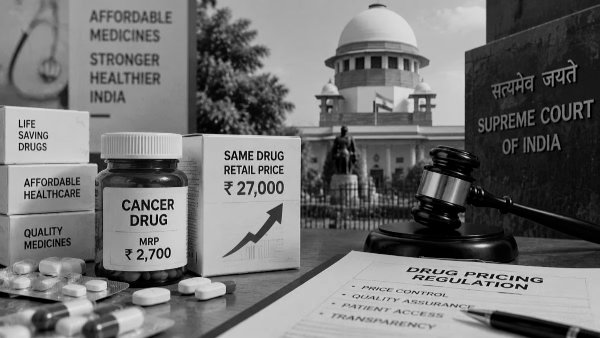
New Delhi: The Supreme Court has questioned the wide gap between the price at which some cancer medicines are supplied to retailers and the price ultimately charged to patients, asking the Centre to examine whether a uniform 16 per cent limit over the price to retailer could be applied to medicines. The court cited an example in which a cancer drug available to a retailer for about Rs 2,700 carried a maximum retail price of around Rs 27,000.
The issue came up before a bench of Justices Vikram Nath and Sandeep Mehta during proceedings concerning medicine pricing, generic prescriptions and controls over medical devices under the Drugs (Prices Control) Order, 2013. The bench questioned why there should be such a large difference between the price to retailer, or PTR, and the maximum retail price, particularly when the medicine involved is used in serious illnesses such as cancer.
The court’s intervention does not mean that a 16 per cent cap has been ordered. It has asked the government to consider the possibility of a uniform approach, while the Centre has indicated that consultations with officials are required before responding. The matter is scheduled to be heard again on October 12.
Why the PTR-MRP gap matters to patients
The difference between PTR and MRP can become particularly significant when a patient requires expensive medicines over a prolonged period.
PTR refers to the price at which a medicine is supplied to a retailer, while MRP is the maximum price printed on the package at which it can be sold to a consumer. A large gap between the two does not by itself establish how much profit is retained at every stage of the supply chain, because pricing can involve manufacturers, distributors, retailers and institutional pharmacies. The court’s concern is that the gap can become exceptionally large in some cases, leaving patients to bear a substantial additional cost.
The example discussed during the hearing illustrates the scale of the issue. The bench referred to a cancer medicine with a PTR of about Rs 2,700 and an MRP of Rs 27,000. That represents an MRP roughly ten times the price to retailer.
For a patient buying a single dose, such a difference is significant. For someone undergoing repeated treatment, the financial impact can accumulate quickly.
The Supreme Court’s 16 per cent suggestion
The bench questioned why the 16 per cent margin referred to under the existing drug-pricing framework could not be applied more broadly.
The court’s discussion needs to be distinguished from an actual regulatory decision. There is currently no Supreme Court order imposing a universal 16 per cent ceiling on every medicine. The judges asked the Centre to examine the possibility of such a uniform rule, while the government sought time to consult officials and work out a response.
The distinction is important because changing the pricing framework for medicines would involve the government and the existing statutory and regulatory system. The hearing is therefore about whether the present structure adequately protects patients from excessive pricing, rather than an immediate change in the MRP of medicines.
The question of hospital pharmacies
The court also raised concerns about patients being required by some corporate hospitals to purchase medicines through in-house pharmacies or specified chemists.
According to reports of the hearing, the bench questioned whether patients could be denied treatment assurances if they obtained medicines from outside pharmacies. It also raised the issue of patients receiving treatment under government-funded schemes, where inflated medicine prices can ultimately affect public expenditure.
That brings the issue beyond private healthcare bills. When treatment is reimbursed through a government scheme, the cost may eventually be borne through public funds. The court therefore connected medicine pricing with the burden on taxpayers as well as the financial pressure on individual patients.
What the existing pricing system does
India already regulates the prices of medicines under the Drugs (Prices Control) Order. Scheduled formulations are subject to price controls, while the treatment of non-scheduled medicines is different.
During the proceedings, the court questioned the distinction between medicines covered by price controls and those outside the scheduled category. A petition before the court has argued that a large majority of medicines fall outside the scheduled list and therefore do not have the same form of upfront price control.
The government now has to respond to the court’s concerns and explain how the existing system addresses the gap between PTR and MRP, particularly for medicines that can impose a heavy financial burden on patients.
Why cancer medicines have become the focus
Cancer treatment frequently involves multiple medicines, repeated cycles of treatment and extended medical supervision. The cost of drugs can therefore become a major part of a family’s overall treatment expenditure.
A high MRP becomes especially consequential when patients are purchasing medicines through a hospital-linked pharmacy and have limited practical options to compare prices. The court’s questions about hospital pharmacy practices are therefore closely connected to its wider concern about the final amount patients are required to pay.
The hearing also raises a broader issue of transparency. Patients may know the MRP printed on a medicine package, but they may not know the PTR, the margins applied at different stages or whether a cheaper equivalent is available through another channel.
For families already dealing with the cost of treatment, that information can affect purchasing decisions.
What happens next
The Centre has not rejected the court’s concerns. Solicitor General Tushar Mehta told the bench that the government would need to consult officials and find a way forward while balancing different interests. The court has given the Centre time to respond and has fixed the next hearing for October 12.
Until then, there is no new universal 16 per cent medicine-price cap in force as a result of Tuesday’s hearing. What has changed is the level of scrutiny around the gap between the price at which medicines reach retailers and the amount patients may ultimately be asked to pay.
The Supreme Court will hear the matter again on October 12, when the Centre is expected to respond to the concerns raised over medicine pricing, hospital pharmacy practices and the proposed approach to limiting excessive mark-ups.
