
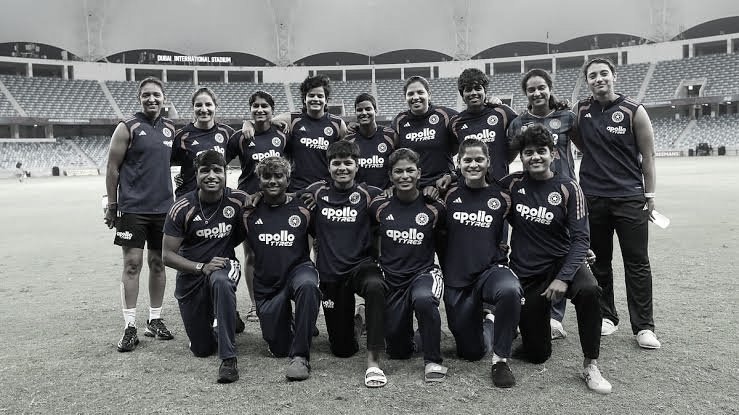
India’s women’s cricket team has begun its defence of the T20 gold medal at the 2026 Asian Games with a victory over Japan, opening another chapter in the rapid expansion of women’s cricket on the international multi-sport stage. The Indian team arrived in Nagoya after a demanding international schedule and began its campaign with a strong quarter-final performance.
India’s women’s team defeated Japan in the quarter-final, with Sree Charani taking four wickets for 10 runs in four overs. The performance came shortly after India’s successful Women’s Asia Cup campaign and a long journey from Dubai to Delhi and then to Nagoya.
The immediate result matters, but the larger story is the changing place of women’s cricket in Indian sport.
From participation to expectation
Women’s cricket in India has spent years moving from the margins of sporting coverage towards regular prime-time attention. The change is visible not only in television audiences and professional leagues but also in the expectations placed on the national team.
At the Asian Games, that expectation takes a different form. The competition places cricket alongside athletics, shooting, boxing, wrestling, swimming and dozens of other sports, making the women’s team part of India’s wider multi-sport sporting programme.
India is defending the T20 gold medal won at the previous Asian Games.
A 503-athlete Indian contingent
India is sending 503 athletes to the 2026 Asian Games, including 269 men and 234 women. The contingent is supported by 265 members of support staff, including coaches and other personnel.
The numbers matter because the representation of women within a national sporting contingent increasingly reflects the depth of India’s participation across disciplines.
Women are not present only in a handful of traditionally successful events. They are competing across team sports and individual events, with athletes arriving through different competitive pathways.
The Asian Games provide one of the largest platforms for that participation.
What comes after the medal
A gold medal is the most visible outcome of a sporting campaign, but a strong women’s sporting system depends on what exists before and after the medal.
Young girls need access to facilities, coaching and competition. Families need confidence that sporting careers can be sustained. Athletes need professional support, injury management, travel arrangements and opportunities to compete regularly.
Women’s cricket has benefited from increasing professionalisation, but the same infrastructure question applies across sports.
The presence of 234 women athletes in India’s Asian Games contingent is one measure of progress. The next question is whether that participation continues to expand after the spotlight moves away from Nagoya.
The Asian Games as a larger opportunity
The 2026 Asian Games begin officially on September 19 and run until October 4. Around 17,000 athletes and officials from 45 countries and regions are expected to participate across 43 sports and 469 medal events.
For Indian women athletes, the Games provide competition against the strongest sporting nations in Asia and, in some disciplines, pathways towards future Olympic qualification.
The women’s cricket team’s campaign is therefore one part of a much larger sporting programme.
India’s title defence has already begun. The next matches will determine how far the team goes in Nagoya, but the continued presence of women’s cricket at major multi-sport events is itself part of the changing structure of Indian sport.
