
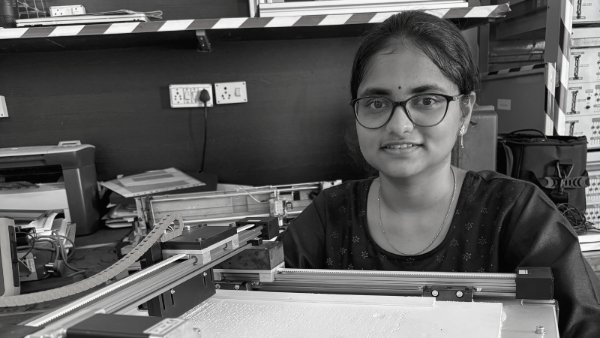
Hyderabad: A visit to a school for visually impaired children changed the direction of engineering student Himaja Lingampalli’s project. What she saw there – students working with traditional Braille writing methods that required considerable physical effort and familiarity with dot patterns – led her to develop a voice-enabled system designed to convert spoken words into Braille.
Her project, Rudhra, has now won the 2026 James Dyson Award in India. Himaja, a fourth-year BTech student at Sri Vishnu Engineering College for Women in Andhra Pradesh, will receive a ₹6 lakh prize and will represent India at the international stage of the competition.
The award is the latest part of the story.
The more interesting part began in a classroom.
How did the idea for Rudhra begin?
Himaja developed the idea after visiting a school for visually impaired children near her college.
Traditional Braille writing uses a slate and stylus to create raised dots on paper. The method is widely used, but it requires the user to physically press the stylus into the paper and understand the dot combinations that form different characters.
During her visit, Himaja saw the effort involved and began considering whether technology could simplify the process without taking away the tactile nature of Braille.
That became the starting point for Rudhra.
The first version was not voice-controlled.
Himaja initially built a device in which users selected the required Braille dots using buttons. She then worked on a voice-based system, using speech technology to allow the device to recognise spoken words and convert them into Braille output.
That development is important because it shows that the final product did not appear fully formed.
It was tested, changed and simplified.
What does Rudhra actually do?
The current system converts spoken words into Braille and prints the corresponding pattern.
For someone familiar with conventional Braille writing, the difference is in how the information is entered.
Instead of manually creating each character by pressing the appropriate dots, the user can speak. The device then processes the word and produces the Braille pattern.
The resulting dots can be touched and read by the user.
According to reporting on the project, the design also seeks to reduce the need to reverse the paper and mentally remember the corresponding dot arrangement while reading the output.
That does not mean Rudhra replaces Braille education.
It is intended as an assistive tool.
That distinction matters because Braille remains a literacy system, not simply a method of printing words. Technology can reduce physical effort or make certain tasks easier, but learning to read and write Braille continues to have educational importance.
Why is this relevant to engineering students?
There is a lesson in the origin of the project that is easy to miss when the award becomes the headline.
Himaja did not begin with a technology looking for a problem.
She encountered a problem first.
That approach is particularly relevant to engineering education, where students are often encouraged to build projects around emerging technologies, competitions or academic requirements. A working prototype may satisfy a course requirement, but a product designed around a real user’s difficulty has a different starting point.
The school visit gave Himaja access to that real-world problem.
The subsequent work involved adapting the idea to an actual user need.
Can assistive technology become affordable?
That remains an important question for any innovation of this kind.
Winning an award and producing a prototype are not the same as deploying a device at scale.
An assistive technology product has to work reliably, remain affordable and be easy enough for users, families, schools and support organisations to maintain. It also needs appropriate testing before being relied upon in classrooms or other settings.
The cost of components, printing materials, voice-recognition technology and maintenance can all affect the final price.
Those practical questions are likely to matter if Rudhra moves beyond the competition stage.
The ₹6 lakh award gives the project resources and recognition, but further development will determine how far the device can go.
Why the project has relevance beyond one college
Assistive technology often develops around very specific problems.
That is not a weakness.
A device that solves one difficult task well can become useful to a much larger group if it is reliable, affordable and adaptable.
The potential audience for a Braille-writing aid includes schools for visually impaired children, special-education institutions, families and individuals who already use Braille as part of their education or daily life.
But accessibility technology also has to be designed with users rather than simply for them.
The people who will use the device need to be part of testing and development. Their feedback can reveal problems that may not be obvious in a laboratory or college project.
Himaja’s original school visit therefore remains an important part of the story.
The project began with observation.
What happens next for Rudhra?
Winning the Indian James Dyson Award gives Himaja a national platform and a place in the international stage of the competition. The project will now face a broader field of evaluation.
Its next challenge is not simply another prize.
It is development.
The device will need continued testing, refinement and assessment of how effectively it serves visually impaired users in real settings.
For a student project, that is a substantial next step.
For the students who inspired it, the measure will be simpler: whether the technology makes Braille writing easier without making the learning process less meaningful.
Himaja will now represent India at the international stage of the 2026 James Dyson Award.
