
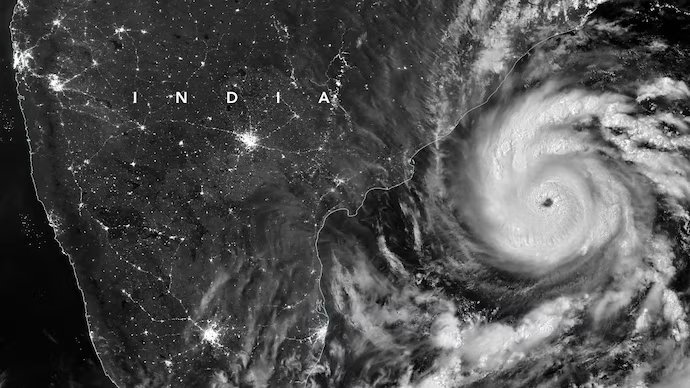
Amaravati: As Severe Cyclonic Storm Murasu advances towards the south Andhra Pradesh coastline, the immediate concern is the safety of communities living along the coast and in low-lying areas, with the India Meteorological Department (IMD) forecasting landfall between Nellore and Narsapur, close to Ongole, around midnight on Monday and the early hours of Tuesday.
The storm was located over the west-central Bay of Bengal near latitude 14.1°N and longitude 81.4°E at 8.30 am on Monday, according to the IMD’s bulletin. It was approximately 160 km east-southeast of Nellore and 210 km southeast of Ongole, moving west-northwestwards at around 22 kmph.
The IMD has forecast sustained wind speeds of 100-110 kmph, with gusts reaching 120 kmph, during the expected landfall. The forecast window extends from 11.30 pm on November 2 to 4 am on November 3. The department has also warned of a possible storm surge of around 1-1.5 metres above the astronomical tide, which could inundate low-lying coastal areas.
The projected impact makes the coming hours particularly important for fishing communities, coastal households and people living in settlements vulnerable to flooding. Strong winds and rough sea conditions can disrupt fishing activity, damage temporary structures and affect transport and power infrastructure. Heavy rainfall could add to the difficulties in areas already exposed to coastal flooding.
The IMD has identified Bapatla, Krishna and Prakasam districts among the areas where storm-surge-related inundation is a concern. The actual extent of flooding will depend on the storm’s track, the timing of landfall and local coastal conditions.
For residents, the priority is to follow instructions issued by district administrations and disaster-management authorities. Fishermen should remain away from the sea in accordance with official advisories, while households in vulnerable locations should pay attention to evacuation instructions and warnings issued through authorised channels.
The approaching storm also places attention on the importance of local preparedness. Timely communication, access to safe shelters, emergency services and arrangements for vulnerable residents are central to reducing risks during a cyclone. The effectiveness of these measures will become clearer as district authorities respond to changing conditions.
Murasu is expected to weaken after crossing the coast, according to the IMD’s forecast. However, the period around landfall could bring damaging winds, heavy rainfall and coastal inundation. Residents should therefore continue to treat official warnings seriously even as the storm moves inland.
The immediate measure of preparedness will not be the number of warnings issued, but whether people in exposed locations receive timely information and are able to move to safety before conditions deteriorate.
