
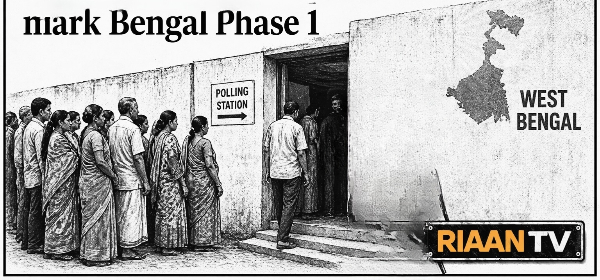
Kolkata: The first phase of the West Bengal Assembly Elections 2026 has set an early tone for the contest — marked by high voter participation, extensive security deployment and a handful of localised disruptions that kept the administration on alert.
Polling across 152 constituencies in 16 districts concluded with a turnout of 89.93 per cent, one of the higher figures recorded in recent elections. From the tea garden belts of North Bengal to the rural stretches of Murshidabad and the tribal regions of Jhargram, voters turned up in large numbers, forming queues well before polling hours began.
The scale of participation is being seen as a key indicator of voter engagement in this election cycle. Nearly 3.6 crore voters were eligible in this phase, with 44,000-plus polling stations set up across diverse geographies — border districts, minority-dominated areas, urban pockets and remote rural regions.
Turnout sets the early narrative
Several districts crossed the 90 per cent mark, with South Dinajpur recording the highest turnout, followed closely by Cooch Behar, Birbhum, Murshidabad and Jalpaiguri. Even districts with relatively lower participation maintained steady polling throughout the day.
Women, youth and elderly voters were visible in significant numbers, suggesting a broad-based engagement rather than isolated spikes.
High turnout in Bengal has historically been closely watched for political signals, though its direct translation into electoral outcomes often varies. For now, it has ensured that the first phase remains politically significant.
Security presence shapes the day
One of the defining features of the phase was the scale of security deployment.
Over 2,400 companies of central armed forces were stationed across districts, supplemented by state police, surveillance teams, flying squads and sector officers. Sensitive booths were placed under additional monitoring, including webcasting and live reporting systems.
The heavy deployment appeared to have a stabilising effect in many areas, with polling proceeding smoothly for most of the day.
Leaders, including Leader of the Opposition Suvendu Adhikari, publicly called for peaceful voting, reflecting the broader emphasis on maintaining order during the process.
Ground realities: calm with interruptions
Despite overall control, the day was not entirely without incident.
Sporadic reports emerged from districts such as Murshidabad, Birbhum, South Dinajpur and West Midnapore, where allegations ranged from localised clashes and voter obstruction to EVM-related disruptions.
In Domkal, complaints regarding access to polling booths led to intervention by security forces, after which voting resumed. In other areas, minor technical issues temporarily affected polling before being resolved.
These incidents, while limited in scale, highlighted the continued sensitivity of certain constituencies, particularly in politically competitive zones.
Human moments amid the process
Beyond numbers and security arrangements, the day also reflected the human dimension of elections.
In Naoda, a woman who had lost her husband in earlier violence cast her vote and spoke about her continued wait for justice. Such moments, though isolated, underscored how past events continue to shape voter experiences in some areas.
At the same time, the presence of elderly voters, first-time participants and women standing in long queues pointed to a wider engagement with the electoral process.
International attention and systems on display
An international delegation visiting West Bengal during the polling process toured booths in the Siliguri region, reviewing arrangements and interacting with officials.
Observers noted the scale of election management, including facilities for voters, digital monitoring systems and accessibility measures — elements that have increasingly become part of India’s electoral framework.
What the first phase suggests
While it is too early to draw conclusions, the first phase offers a few clear signals.
High turnout indicates strong participation across regions, while the extensive security presence suggests a continued focus on maintaining order in sensitive areas.
At the same time, isolated disruptions point to underlying local tensions that may continue to surface in subsequent phases.
For political parties, the phase provides early ground feedback — particularly from North Bengal, border districts and rural belts — which are often seen as crucial in shaping overall outcomes.
The road ahead
The remaining 142 constituencies will go to polls in the second phase on April 29, with attention now shifting to turnout patterns, campaign strategies and administrative preparedness.
Counting of votes is scheduled for May 4.
For now, the first phase stands as a mix of strong voter participation, controlled administration and the familiar complexity that defines elections in West Bengal.
