
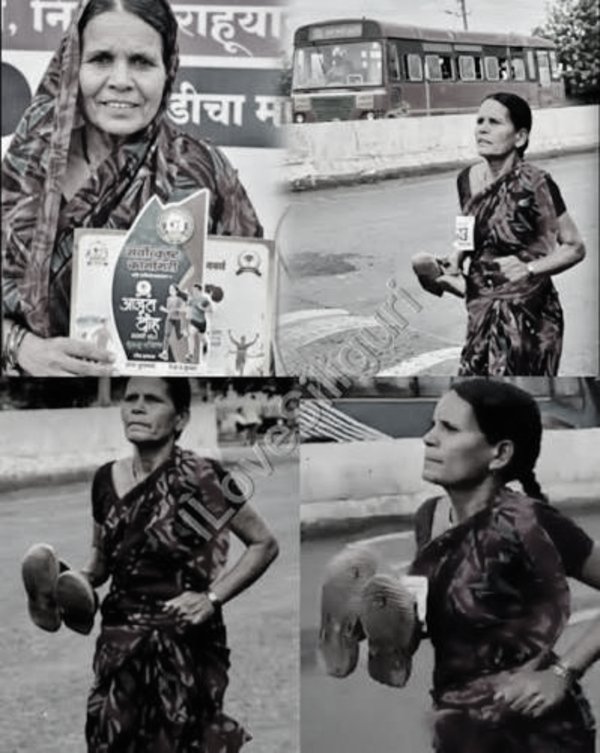
National Commission for Women (NCW) Chairperson Vijaya Rahatkar on Friday spoke to 47-year-old Ramabai Ashok Ranvir of Maharashtra’s Beed district and assured her of support, including ₹1 lakh in financial assistance, after the woman’s barefoot run for her daughters’ education drew widespread attention. Rahatkar also directed the local administration to ensure that Ramabai and her two daughters receive the government benefits they are entitled to.
A few days ago, Ramabai was known mainly in her village. She is now being spoken about far beyond Beed.
Her story became public after she ran three kilometres barefoot, wearing a sari, in a local race. She had entered the event hoping to win prize money that could help with her daughters’ education.
What happened after the race is now a different part of the story.
The call from the Women’s Commission
Rahatkar spoke to Ramabai by phone on Friday and assured her that the commission would extend all possible assistance.
She also said ₹1 lakh would be given to Ramabai from the prize money she herself had received through a recent award. The NCW chairperson directed officials to make sure the family receives benefits available under government welfare schemes.
For Ramabai, the intervention comes after several difficult years.
Her husband died in 2012. Since then, she has been raising her two daughters and working as a cook to support the family. One daughter is preparing for banking examinations, while the other is training for police recruitment.
The race that changed the story
Ramabai had no running shoes or formal training when she joined the three-kilometre race in Ambajogai.
She started the race in a sari and slippers. When the slippers became difficult to run in, she took them off and continued barefoot.
She eventually won her category.
The prize money mattered to her because she had a very specific use for it – her daughters’ education. Reports said she used part of the money to buy notebooks and pens.
The video of her running barefoot quickly travelled across social media, turning a local race into a national story.
But the attention also raised a less comfortable question.
Why did a mother have to run a race for a few thousand rupees to meet basic educational needs for her children?
What happens after the headlines?
That is where Ramabai’s story becomes more than an inspirational account.
The NCW’s intervention means the focus has now shifted from the race to the family’s situation.
The commission has asked the local administration to look at the welfare support available to Ramabai and her daughters. Whether that support reaches the family in a meaningful and sustained way will now matter more than the attention generated by the video.
Ramabai’s circumstances are also a reminder that government schemes can look very different on paper and in the lives of people who need them.
A family may be entitled to assistance, but knowing about a scheme, applying for it and actually receiving the benefit are three different things.
For Ramabai, that gap may now begin to close.
Her daughters remain at the centre
The race was never really about running.
It was about two daughters and a mother trying to keep their education going despite limited means.
One daughter is preparing for banking examinations and the other for police recruitment. Their mother’s decision to enter the race came from the same practical concern that has shaped her life since her husband’s death – finding a way to keep the household going and give her children an opportunity.
The national attention may eventually disappear. Social-media posts will move on to the next story.
But for Ramabai, the important part begins now.
The question is no longer who saw her run.
It is what changes for her family after everyone has seen her.
