
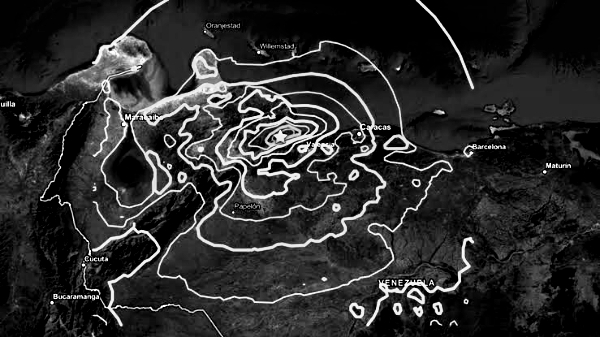
New Delhi: When news broke of the powerful earthquakes that struck Venezuela this week, most headlines focused on the numbers – magnitude 7.2 followed seconds later by an even stronger 7.5 earthquake.
While the magnitude immediately indicated the strength of the seismic event, geologists and disaster experts quickly drew attention to another figure that received far less public attention: the depth.
One of the earthquakes originated about 22 kilometres below the Earth’s surface, while the second, more powerful tremor struck at a depth of just 10 kilometres. That relatively shallow depth played a major role in determining the extent of the destruction witnessed in parts of Venezuela.
The incident has once again highlighted an important fact about earthquakes: the magnitude alone does not determine how destructive an earthquake will be. The depth at which it occurs is equally important.
### Understanding earthquake depth
Every earthquake begins beneath the Earth’s surface at a point known as the focus or hypocentre. The point directly above it on the Earth’s surface is called the epicentre.
The distance between the focus and the Earth’s surface is referred to as the earthquake’s depth.
Scientists generally classify earthquakes into three categories. Shallow-focus earthquakes occur at depths of less than 70 kilometres, intermediate earthquakes occur between 70 and 300 kilometres, while deep-focus earthquakes originate at depths greater than 300 kilometres.
The Venezuela earthquakes fell into the shallow-focus category.
### Why shallow earthquakes are more dangerous
The explanation is relatively simple.
Earthquakes release enormous amounts of energy in the form of seismic waves. The closer these waves originate to the Earth’s surface, the less distance they have to travel before reaching buildings, roads and other structures.
Because the waves lose very little energy during this short journey, they strike the surface with greater intensity.
Imagine dropping a heavy stone into a shallow pond. The ripples reach the edges almost immediately with much of their force still intact. In a much deeper pond, those waves spread farther and gradually lose energy before reaching the banks.
Earthquakes behave in a similar manner.
A shallow earthquake allows powerful seismic waves to hit the ground almost directly, resulting in violent shaking over the affected region.
### Why deeper earthquakes may feel different
This often surprises people.
A deeper earthquake can register a similar or even higher magnitude yet cause less destruction near its epicentre.
The reason lies in energy dissipation.
As seismic waves travel upward through hundreds of kilometres of rock, part of their energy is absorbed by the Earth’s crust. By the time they reach the surface, the shaking may be felt across a wider geographical area but with lower intensity.
This explains why some deep earthquakes are experienced across several countries while causing relatively limited structural damage.
### Magnitude is only one part of the story
Magnitude measures how much energy an earthquake releases.
Depth determines how that energy reaches people on the surface.
Both factors work together.
For example, a magnitude 6.5 earthquake occurring at a depth of 10 kilometres in a densely populated city can sometimes prove more destructive than a magnitude 7 earthquake occurring much deeper underground or in a remote location.
That is why seismologists rarely assess earthquake risk based solely on magnitude.
### Other factors influence damage
Earthquake impacts depend on several additional conditions.
Population density is one of the biggest factors. A strong earthquake beneath an uninhabited region may cause very little damage, while a similar event beneath a major city can become a disaster.
The quality of buildings also plays a crucial role. Structures designed to withstand seismic activity perform much better than poorly constructed buildings.
Local geology matters as well. Soft soils tend to amplify shaking, whereas hard rock generally reduces its impact. The distance from the epicentre, local topography and preparedness levels also influence the final outcome.
### Lessons beyond Venezuela
The Venezuela earthquakes serve as another reminder that earthquake science extends far beyond a single number reported in headlines.
For countries like India, which has several seismically active regions including the Himalayas, Northeast India, Gujarat and parts of the Andaman and Nicobar Islands, understanding earthquake behaviour remains important for disaster preparedness.
Scientists emphasise that earthquakes cannot yet be predicted with precision. What can be improved, however, is preparedness through better building standards, stronger infrastructure, public awareness and effective emergency response systems.
The latest earthquakes in Venezuela reinforce a lesson repeatedly observed across the world: when it comes to earthquakes, how deep they occur can be just as important as how powerful they are.
