
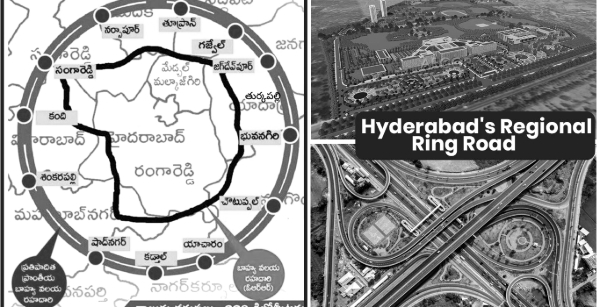
Hyderabad: The Centre’s decision to develop the proposed Regional Ring Road (RRR) around Hyderabad as a National Highway instead of a high-speed access-controlled expressway has triggered discussion about what the changes could mean for the city’s long-term infrastructure planning.
The Regional Ring Road has been projected as a major transport corridor intended to improve connectivity between districts surrounding Hyderabad and reduce pressure on the existing road network, particularly the Outer Ring Road (ORR).
The project is also seen as part of a larger effort to support industrial corridors, logistics movement and satellite town development around the Hyderabad region.
One of the key changes in the revised plan is the reduction in design specifications compared to the earlier proposal. The project, which was initially discussed as an eight-lane high-speed corridor, is now expected to be developed with six lanes based on present traffic projections.
Officials involved in infrastructure planning often point out that such changes are not uncommon in large highway projects, as designs are usually aligned with cost considerations and traffic feasibility studies.
Another change relates to speed design standards. While earlier discussions indicated higher speed movement similar to expressway models, the revised project is expected to follow National Highway design norms.
Urban planners say the long-term value of the RRR lies less in speed and more in connectivity. By linking multiple national and state highways, the corridor is expected to help divert heavy commercial vehicles away from the city and reduce congestion on inner transport corridors.
The project is also expected to improve access to emerging growth areas outside Hyderabad by creating better road connectivity between districts and industrial zones.
Some earlier proposals such as continuous lighting along the entire stretch and extensive service road networks have also been modified in the revised design. Experts say such decisions are often taken based on cost optimisation and practical usage requirements.
Transport planners note that large infrastructure projects usually go through several design adjustments before final execution, particularly when they involve long corridors and large land acquisition components.
Despite the design changes, the RRR is still expected to play an important role in shaping the Hyderabad region’s future growth pattern by encouraging decentralised development and reducing dependence on the city core.
For commuters, the project is expected to provide an additional bypass corridor once completed, while for industry it could improve logistics connectivity between different regions of the state.
As Hyderabad continues to expand beyond its traditional limits, projects such as the Regional Ring Road are seen as long-term infrastructure investments aimed at managing future urban growth.
The key question now will be how quickly the project progresses and how effectively it integrates with the region’s existing transport network.
