
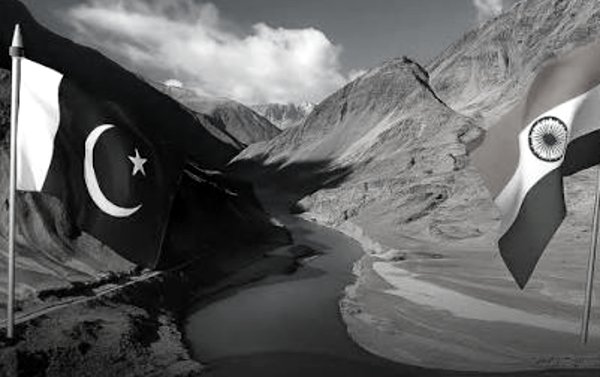
New Delhi– India has rebuffed a recent decision by the Hague Permanent Court of Arbitration concerning the standing condition of the Indus Waters Treaty. It had been ruled that the long-standing water sharing treaty between the countries, continues to be in effect and operative. However, New Delhi has rejected the verdict without hesitation, citing that international arbitration has been invested with neither the authority, nor the legal footing.
The Conflict over International Power The court recently held in its decision that India could not suspend the treaty at will and must remain in adherence to the existing agreements for water usage across the entire Indus river basin.
The decision from Hague was stringent in imposing limitations over certain designs and structures concerning ongoing works on projects such as the Ratle hydroelectricity facility being built in the state of Jammu and Kashmir. New Delhi has vehemently dismissed the verdict – refusing to acknowledge its validity on the ground that India does not subscribe to the legality of The Court of Arbitration in any matter and has been consistent in withdrawing itself from the processes of the arbitration. Statements made by Indian officials imply that the nation has been explicit in its stance that no external arbitration mechanism is privy to interfering with sovereign actions to be undertaken by the nation state. Timeline and Framework for the Indus River Treaty: April 2025 The Background to the Conflict The whole protracted dispute arises from a decision of the Indian government in April 2025 of placing the treaty under abeyance after the attack at Pahalgam to which New Delhi alluded thatcross-border elements were responsible.
It is still relevant to note that Pakistan denied that any of its nationals had any part to play in the attack that led to major changes in the long-standing arrangements between the countries concerned.
Historical Background The treaty signed on 1960 has been operational and has provided water to the region by managing the distribution of water in the country. The system of the treaty continues to run the sharing of water since its signing although several diplomatic rows and conflicts took place over the past few years. The situation now involves a challenge to the established order as the arbitration court determined in September 2026 that India must carry out its treaty obligations with respect to hydropower projects being built in J&K.
The ruling of the court was strongly in favour of Pakistan when it stated that India must suspend the installation phase at the Ratle site before the neutral engineer’s report is due to come in July 2027 and then decide about moving forward on these. The Indo-Pak river management the Permanent Court of Arbitration will oversee India and Pakistan to resolve issues over the Ratle dam The water sharing project that is underway and managed through the system works in India and is meant for generation of electricity in J&K state will have to be put to hold under the supervision of international arbitration court with reference to river Indus. As per the IWT, India as upstream developed nation has powers to generate its power through hydro-electricity generation but at the same time, it is expected not to divert the rivers towards its needs in the way that can cause losses to the other developed nation of Pakistan who is receiving water in the down stream.
The Indus Waters Treaty framework is critical for irrigation and the flow of water in Pakistan, with an extensive network of canals carrying it downstream.
Whilst the Treaty granted India rights to build upstream hydropower projects it had specified design and engineering stipulations. All previous, and other issues concerning technical arrangements, would be resolved through inter-state bilateral mechanisms. The present dispute, unlike those prior, entails an intervention challenge over the international arbitration framework itself. The current stance will be unlikely to result in a shift in realities on the ground, as New Delhi will continue to pursue its priorities in J&K given the rejection of the court’s mandate, and Islamad would continue to rely on arbitration as a tool of ensuring its access to the waters.
With regard to communities in either side of borders, this dispute goes far beyond political posturing, since decades of mutual conflict failed to derail the water sharing arrangement between the states in spite of having the risk of war.
