
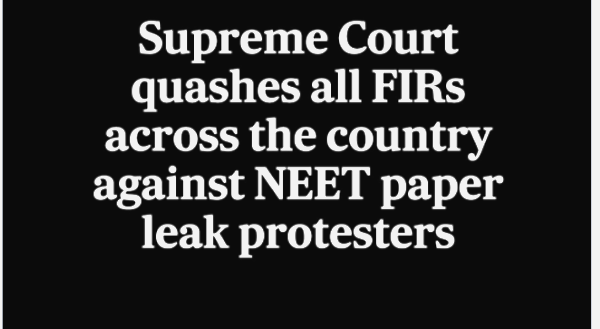
NEW DELHI: The Supreme Court on Tuesday ordered the closure of all First Information Reports (FIRs) registered across the country in relation to the protests students undertook between July 20 and 25 amid the NEET paper-leak agitation, saying that these cases need not be prosecuted and investigated and must be treated as closed, giving a welcome reprieve to protesting students. These FIRs, filed in various states, fall under the scope of the order and cover all protesting students across the country.
The court also directed that no further FIRs will be filed by any state or Union Territory in relation to incidents falling under this order.
A three-judge bench headed by Chief Justice of India Surya Kant used its special powers under Article 142 of the Constitution to issue the order, stating that the decision was made in consideration of the future of the protesting students, whom the court viewed as acting in good faith. Both the Centre and numerous states had approached the Supreme Court requesting that these cases be closed. What the order means for protesting students For students targeted by FIRs, it’s not merely a statistic on police records. A criminal case can have significant ramifications when applying for further education, scholarships, public employment, or anything else that requires a background check.
This Supreme Court order provides students with much-needed clarity regarding such protests that have been covered by the judgment.
These FIRs emerged in the wake of the NEET examination scandal, and students had taken to the streets in July to voice their demands concerning the exam. With this decision, the court has drawn a line under these cases. This relief is widespread but not absolute.
It’s important to note that the order does not encompass all issues or allegations related to the protests without any caveats. For instance, the court allowed the Delhi Police to continue with an FIR involving 2,873 people found at the Jantar Mantar protest, citing evidence of serious criminal antecedents in that specific case. This distinction is crucial.
The court’s order is specifically for students who genuinely and with honest intentions participated in the protests mentioned, and it does not grant blanket protection from the legal system for unrelated crimes or individually serious accusations.
The bench also emphasized that the ruling was based on the specific facts of the case before it and should not be treated as a universal precedent for all protest-related cases. A second ray of hope for students Meanwhile, in response to the plight of students affected by the cancellation of NEET-UG 2026, the Solicitor General informed the court that a compensation policy for the families of students who died by suicide would be formulated within three months, as reported by Akashvani News. This aspect of the proceedings adds another layer to a crisis that has already impacted thousands of students and families. Many students view academic disputes not as abstract policy debates but as life-altering events.
A cancelled exam or a delayed college admission or protracted legal processes can lead to years of uncertainty.
What has the Supreme Court changed?
The direct impact of Tuesday’s order is clear: all FIRs that fit the court’s criteria should no longer be pursued. These cases should be dropped, and investigations should halt.
States and Union Territories have also been instructed not to file new FIRs for the protest-related incidents covered by the order. This decision brings a degree of finality for the students who participated in the demonstrations and faced legal repercussions. However, the overarching debate on the NEET examination, including issues of exam security and student confidence, remains relevant for India’s education system.
For the students facing these FIRs, the Supreme Court’s order means that a protest that could have left them with a criminal record can now, largely, be put behind them.
