
Something interesting is happening on our screens.
The 1980s are back.
Vintage photographs, old-school colours, retro fashion and images with the unmistakable feel of another era are suddenly everywhere. With AI, people can now transform an ordinary photograph into something that looks as though it came from an old family album or a magazine from decades ago.
At first glance, it is simply another social-media trend.
But I find something else interesting about it.
Because what people are rediscovering today is something we had already chosen to hold on to much earlier.
Why are we suddenly looking backwards?
We live in a world where everything is instant.
Take a photograph. Edit it. Post it. Scroll past it.
Everything is sharper, faster and more polished than ever before. Yet, somewhere in the middle of all this digital perfection, people seem to be developing a taste for things that feel less perfect.
A photograph that looks as though it has lived a little.
A design with character.
A newspaper-style page.
Colours that don’t scream for attention.
Perhaps this is not really about the 1980s.
Perhaps it is about our growing attraction to things that feel less disposable.
The irony of technology
We have built technology capable of creating almost anything.
And now we are using that technology to recreate the feeling of something that technology once seemed determined to replace.
That is what makes the vintage revival interesting.
We are not necessarily asking for the past to return.
We may simply be missing something about it.
A photograph was something you kept.
A newspaper was something you held.
A story was something you sat down to read.
Things had imperfections, but those imperfections were part of their character.
Today, even that feeling can be recreated digitally.
What the world is rediscovering, we had chosen long back
This is where the trend connects with me – and with RIAAN.TV.
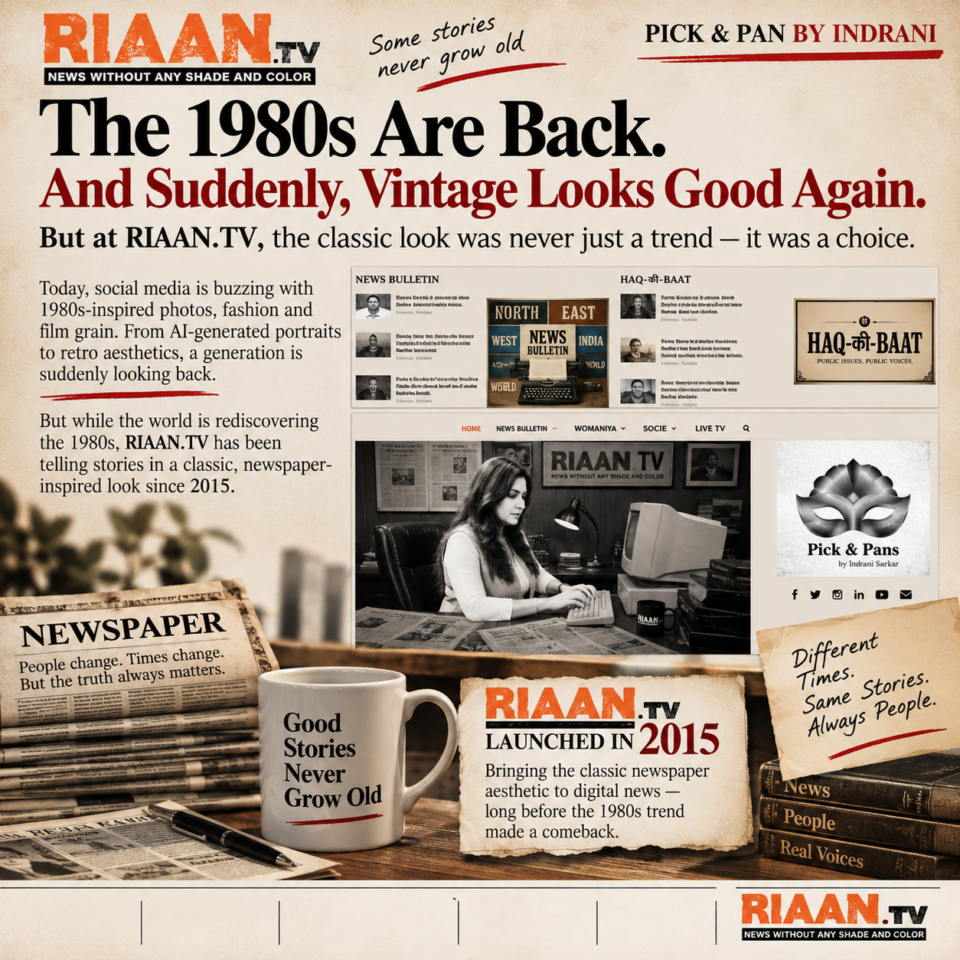
When RIAAN.TV was launched in 2015, we did not believe that becoming digital meant abandoning everything that came before.
Our idea was to carry forward the character of traditional journalism while embracing the possibilities of digital media.
Classic in character. Digital in delivery. Contemporary in journalism.
That thinking was never about making a digital news platform look old.
It was about understanding that technology can change the way journalism is delivered without forcing us to throw away everything valuable from the past.
Today, as vintage aesthetics and old-school visual language are finding their way back into an intensely digital world, that idea feels surprisingly relevant again.
Maybe the future is not about replacing the past
For years, modernity seemed to mean removing everything that looked old.
But perhaps the future works differently.
Perhaps the future is about choosing what deserves to survive.
We don’t need to go back to the 1980s.
We don’t need to pretend that old technology was better.
And nostalgia should never become an excuse to romanticise the past.
But there are things worth carrying forward.
Character. Context. Memory. Substance.
When almost anything can be created, edited and perfected within seconds, something that feels authentic can become more valuable – precisely because it doesn’t feel disposable.
And that applies to journalism too.
Digital does not have to mean disposable
The internet has made publishing easier than ever.
Anyone can publish.
Anyone can make something look attractive.
Anyone can chase the next trend.
But journalism cannot survive on appearance alone.
It needs a point of view.
It needs context.
It needs memory.
And it needs stories that remain meaningful after the day’s algorithm has moved on.
That is why this little return to the 1980s feels bigger to me than a fashion or photography trend.
The digital world may be rediscovering the value of things that have character.
And perhaps journalism needs that reminder more than ever.
Maybe old isn’t old after all
There is a beautiful irony here.
Yesterday, we were trying to make everything look new.
Today, we are using the newest technology to make things look old.
Tomorrow, perhaps we will stop worrying so much about whether something looks old or new.
We will simply ask:
Does it have something to say?
We were not trying to predict the future when we started RIAAN.TV.
We simply believed that some things should not be discarded merely because technology had changed.
Today, the digital world seems to be arriving at a similar conclusion.
Maybe what looks vintage to the world today was never old-fashioned to us.
Maybe it was simply an idea ahead of its time.
