
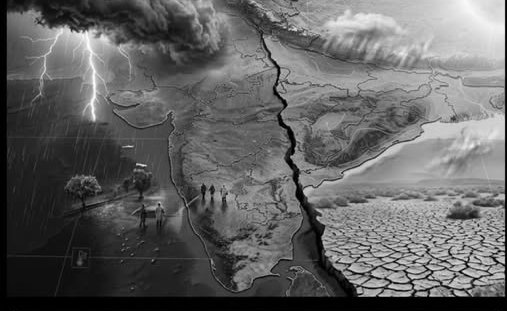
India’s southwest monsoon has begun its withdrawal from parts of west Rajasthan, marking the start of the annual retreat even as a large part of the country continues to face below-normal rainfall. The India Meteorological Department has said the withdrawal began close to its normal date, but as of September 19, around 43 per cent of India’s geographical area remained rain-deficient, with several states recording significant shortfalls.
The national rainfall picture is uneven. Cumulative rainfall from June 1 to September 19 was about 15 per cent below normal, according to the latest figures reported from the IMD. The deficit is particularly pronounced in parts of the Northeast and southern India, where states including Meghalaya and Andhra Pradesh have recorded substantial shortfalls.
The monsoon’s retreat does not mean the rain is finished. A developing weather system over the North Andaman Sea is expected to strengthen and could influence rainfall across parts of eastern and central India during the coming week.
Where the monsoon has started withdrawing
The withdrawal began from parts of west Rajasthan around the normal climatological date of September 17. The withdrawal line has been moving through areas including Ramgarh, Mohangarh, Phalodi and Khajuwala.
The retreat is a normal part of India’s seasonal weather cycle. The southwest monsoon generally begins withdrawing from northwest India in September before gradually retreating from the rest of the country.
What makes this year’s situation more complicated is the uneven distribution of rainfall.
Some regions have received intense spells that produced flooding or local disruption, while other districts continue to record significant deficits. A national rainfall figure therefore cannot fully describe the conditions faced by farmers and communities in individual states.
Andhra Pradesh among the states facing a large deficit
Andhra Pradesh has been listed among the states with major rainfall deficits, at around 43 per cent below normal, while Meghalaya has recorded a deficit of about 59 per cent and Arunachal Pradesh about 41 per cent, according to the latest reported IMD data.
For agriculture, the timing of rainfall can matter as much as the total quantity.
A crop may receive substantial rain during one period but still face water stress if rainfall is absent during a critical stage of growth. Reservoir levels, groundwater availability and the distribution of rainfall across districts can also produce very different conditions within the same state.
That is why the national monsoon figure needs to be read alongside state and district-level data.
Another weather system is developing
The next significant weather development is over the North Andaman Sea.
According to the IMD-linked forecast, the low-pressure system is expected to strengthen into a depression around September 21 and potentially into a deep depression around September 22. It is forecast to move towards the south Odisha and north Andhra Pradesh coast around September 23.
The system could bring moderate to heavy rainfall to parts of Odisha, Gangetic West Bengal, Jharkhand, Chhattisgarh, Sikkim and coastal Andhra Pradesh during the coming week.
This means the beginning of monsoon withdrawal does not translate into an immediate end to significant rainfall activity.
Why the timing matters
September is important for India’s agricultural cycle because many crops are approaching later stages of growth while preparations for the rabi season begin.
Excess rain at this stage can damage standing crops in some regions, while insufficient rain can create problems elsewhere. Farmers therefore need weather information at a much more local level than a simple national monsoon percentage.
The coming week will be important for eastern and central India as the developing system moves inland.
For now, the monsoon has officially begun its retreat from northwest India, but 15 per cent below-normal national rainfall and a 43 per cent geographical-area deficit show that India’s 2026 monsoon season is far from being a uniform weather story.
