
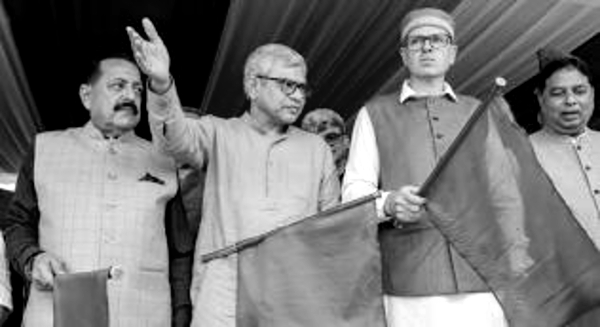
Jammu: At the Jammu station, the excitement is not loud — it is visible in small ways.
People are arriving earlier than usual. Families are standing near the platform longer, looking at the train, taking photos. For many, this is not just another journey. It is the first time they are travelling to Srinagar by train.
Until now, that route mostly meant a road trip.
Anyone who has done it knows what that involves — long hours, sharp turns, sudden halts, weather interruptions. In winter, uncertainty becomes part of the plan. In peak season, delays are almost expected.
That routine is now quietly shifting.
The Vande Bharat service connecting Jammu and Srinagar has begun operations, and with it, the journey itself is changing — not dramatically, but steadily.
Inside the train, the difference shows in conversations.
Some passengers are comparing it to earlier road journeys. Others are simply relieved that the travel is smoother. Elderly travellers, in particular, seem more at ease — no constant movement, no winding roads, no need to prepare for a tiring trip.
A group of pilgrims heading towards the Valley speak about how this makes planning easier. “Earlier, we had to think about road conditions. Now at least one part is fixed,” one of them says.
That sense of predictability is what stands out.
The train runs on time. It follows a defined route. It reduces the unknowns that usually come with travel in the region.
For local travellers, it is also about frequency.
Regular services mean the route is not just for special occasions or long planning. It becomes part of routine movement — something people can depend on.
At the same time, the impact is beginning to show outside the train as well.
Travel operators are already adjusting. Some are reworking itineraries. Hotels and local businesses expect more steady arrivals instead of sudden surges linked only to road conditions.
The change may not be immediate, but it is expected to settle into a pattern over time.
What also adds weight to this shift is the terrain the train crosses.
This is not a simple route. It runs through a region where building infrastructure itself has taken years. Tunnels, bridges and tracks have been laid across difficult stretches to make this connection possible.
For passengers, that effort is not always visible — but it is felt in the experience.
The journey is smoother. The travel time is shorter. The fatigue is less.
Even small things begin to matter.
Looking out of the window instead of focusing on the road. Sitting through the journey instead of bracing for turns. Reaching on time instead of calculating delays.
These are not headline changes, but they shape how people experience the route.
There is also a sense of curiosity.
Many passengers are travelling just to experience the train once. Some say they wanted to see what the route looks like from the tracks. Others simply wanted to try a different way of travelling.
That curiosity is likely to turn into habit over time.
For now, the transition is still new.
The crowds are growing, the conversations are building, and the idea of travelling to Srinagar by train is slowly becoming normal.
The route has not changed.
But the way people move on it has.
