
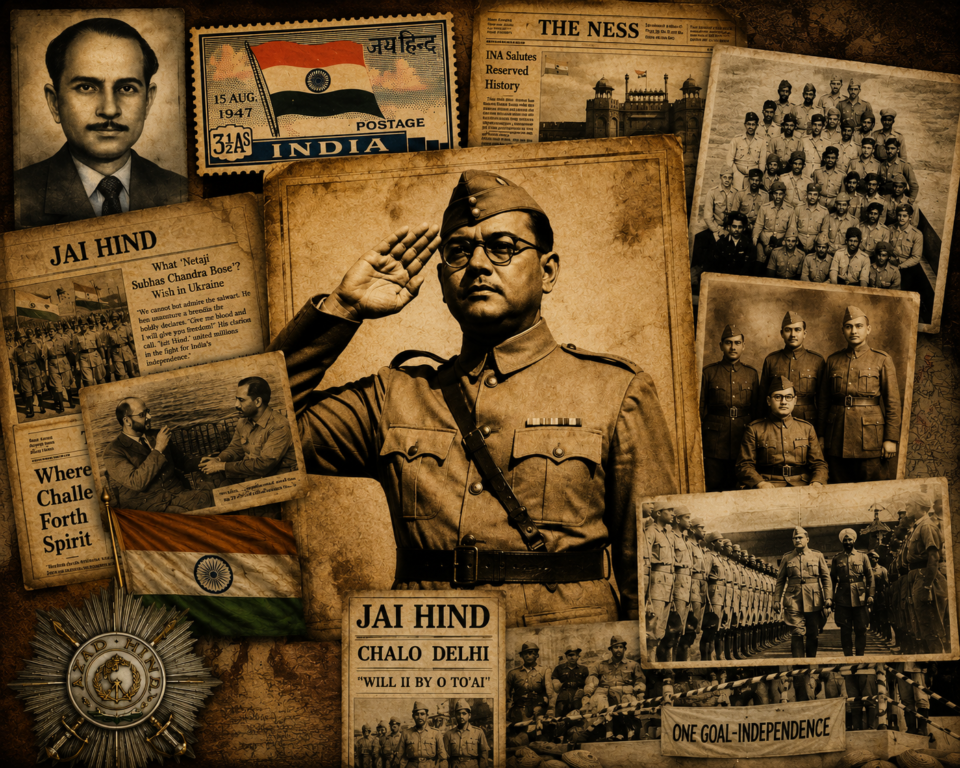
Two words. One nation.
Jai Hind is perhaps one of the simplest expressions in India’s public life. It is heard at military ceremonies, political gatherings, schools, public functions and on Independence Day. For generations, Indians have used it almost instinctively.
But where did it come from?
Who first used it? Who turned it into a national salutation? And how did two short words associated with the freedom struggle become part of the language of independent India?
The story is more complicated — and more interesting — than the familiar version.
1. Who coined “Jai Hind”?
There is no complete historical consensus on the answer.
A widely cited account credits Abid Hasan Safrani, a Hyderabad-born associate of Netaji Subhas Chandra Bose, with developing “Jai Hind” as a common greeting for the Indian National Army.
Another historical account traces the expression to Chempakaraman Pillai, an Indian revolutionary active in Europe during the period before the First World War. Some sources describe Pillai as the originator of the phrase, while accounts of the INA period credit Abid Hasan with suggesting or popularising the shorter form as a common salutation.
What is less disputed is the role played by Netaji Subhas Chandra Bose and the Indian National Army in giving “Jai Hind” a much wider national meaning.
So the question of its origin remains part of the historical story.
The question of its popularisation is clearer.
2. Who was Abid Hasan Safrani?
Born in Hyderabad in 1911 as Zain-al-Abdin Hasan, Abid Hasan came from a family opposed to British rule.
He went to Germany to study engineering, where he came into contact with Bose. He eventually abandoned his studies and joined Bose, becoming his secretary and interpreter.
Hasan later became an officer of the Indian National Army and, after Independence, joined the Indian Foreign Service. He eventually served as India’s ambassador to Denmark.
His Hyderabad connection gives the story a particularly interesting dimension: a man from the Deccan became closely associated with one of the most recognisable patriotic expressions in modern India.
3. Why did the INA need a common greeting?
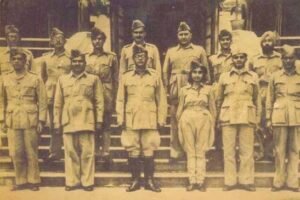
The Indian National Army brought together Indians from different regions, languages and communities.
Bose wanted a form of greeting that could be used by everyone.
Accounts of the period describe the search for a non-religious, non-community-specific salutation for INA soldiers. Greetings associated with particular religious or regional communities could not serve the purpose of an all-India force.
The answer had to be short.
It had to be inclusive.
And it had to place India at its centre.
“Jai Hind” fitted that purpose.
The phrase therefore acquired significance not merely as a slogan, but as a common national greeting.
4. Why did “Jai Hind” become so powerful?
Its strength was its simplicity.
There was no complicated political message in the two words.
Jai conveys victory or glory.
Hind refers to India.
Together, the phrase became an expression of national allegiance.
For the INA, it provided a common identity to soldiers drawn from different parts of India. Under Bose, it became closely associated with the INA and the freedom struggle.
That association helped carry the expression beyond the military context.
5. How did “Jai Hind” enter independent India?
The phrase survived the end of the INA and the achievement of Independence.
One of its most significant early appearances in independent India’s official public language came from Jawaharlal Nehru.
On 15 August 1947, in his first broadcast to the nation as Prime Minister, Nehru spoke of the country’s common allegiance to India and concluded with “Jai Hind!”
In another message issued on Independence Day, Nehru again ended with the words.
The phrase was therefore moving rapidly from the language of the freedom struggle into the vocabulary of the new Republic.
6. Why is “Jai Hind” still used today?
Unlike many political slogans, “Jai Hind” eventually moved beyond the organisation and personalities with which it had first become associated.
It could be used by a soldier, a student, a teacher, a political leader or an ordinary citizen.
It did not require a particular political affiliation.
Its meaning was broad enough to survive changes in governments, generations and political movements.
That may be one reason the phrase has endured for so long.
7. What do those two words mean today?
Perhaps the most interesting part of the story is that “Jai Hind” has become bigger than its own history.
For some, it is a reminder of Netaji and the INA.
For others, it recalls the sacrifices of the freedom movement.
For many Indians, it is simply a patriotic greeting.
But behind the familiar expression lies a larger story about the search for an Indian identity that could transcend region, religion and community.
Its history also reminds us that national symbols are rarely created in a single moment by a single person. They evolve — through movements, people, circumstances and the way later generations adopt them.
That may be the real story of Jai Hind.
Two words that began their journey through the turbulent politics of India’s freedom struggle eventually became a greeting used across the country.
From a revolutionary expression to an INA salutation, and from there into the vocabulary of independent India, “Jai Hind” became more than a slogan.
It became a way of saying, in two words, where one’s allegiance lay.
With India.
RIAAN.TV DEEP FILE
The Story Behind the Story.
