
Moscow/Sanaa: Yemen’s Ansar Allah movement, commonly known as the Houthis, has announced a complete ban on the passage of Israeli-linked vessels through the Red Sea, marking a significant escalation in tensions in one of the world’s most strategically important maritime corridors.
The announcement was made on Monday through a statement issued by the movement, in which it also claimed responsibility for missile strikes targeting what it described as sensitive Israeli sites in the Yaffa region. According to the statement, the missile attacks achieved their intended objectives and formed part of a broader campaign against Israel.
The Houthis declared that all Israeli maritime navigation in the Red Sea would now be prohibited and warned that any vessels linked to Israel would be regarded as legitimate military targets. The group further stated that its armed forces would intensify military operations against Israel in coordination with other regional actors.
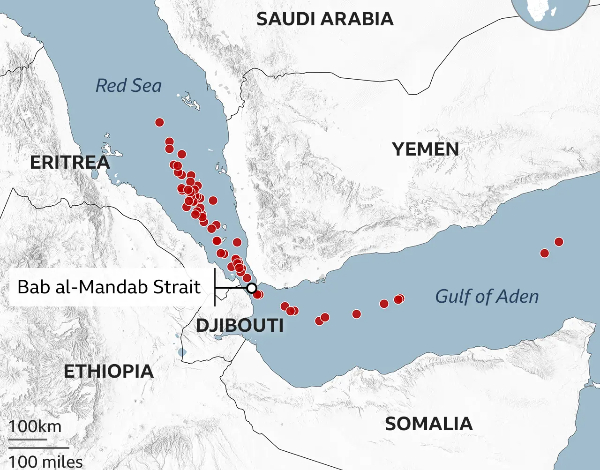
The Red Sea is one of the world’s busiest shipping routes, linking the Mediterranean Sea to the Indian Ocean through the Suez Canal and the Bab el-Mandeb Strait. A substantial portion of global trade, including energy supplies, consumer goods and industrial products, passes through these waters every year. Any disruption in maritime traffic along this route has the potential to affect international supply chains, shipping costs and global trade flows.
The latest declaration comes amid continuing instability in the Middle East, where the conflict involving Israel and various regional groups has increasingly spilled beyond traditional battlefields. Since late 2023, the Houthis have repeatedly launched missile and drone attacks against targets they associate with Israel, arguing that their actions are intended to support Palestinians in Gaza.
These attacks have prompted responses from several countries concerned about freedom of navigation and maritime security in the Red Sea. International naval coalitions have increased patrols in the region, while shipping companies have frequently been forced to reroute vessels around the southern tip of Africa to avoid potential threats. Such diversions significantly increase transportation times and operational costs for global shipping operators.
Security analysts note that the Houthis’ latest declaration represents not only a military challenge but also an economic one. By targeting maritime routes, the group is attempting to exert pressure far beyond the immediate conflict zone. The Red Sea serves as a critical artery for international commerce, and any prolonged disruption could have ripple effects across Europe, Asia, the Middle East and Africa.
The movement’s statement also signals its intention to maintain pressure on Israel through coordinated operations with allied regional actors. While the extent of such coordination remains unclear, observers believe the announcement underscores the increasingly interconnected nature of conflicts across the Middle East.
Israel has not immediately responded to the latest declaration. However, previous Houthi missile and drone attacks have triggered military responses and heightened regional security concerns. The situation remains closely monitored by governments, shipping companies and international organizations responsible for maritime safety.
The Bab el-Mandeb Strait, located between Yemen and the Horn of Africa, remains particularly vulnerable due to its strategic location. Any threat to navigation through this narrow waterway can quickly affect shipping traffic bound for the Suez Canal, one of the world’s most important trade gateways.
Experts warn that further escalation could lead to increased insurance premiums for commercial vessels, disruptions in energy shipments and renewed volatility in global markets. Several international shipping firms have already adopted additional security measures while assessing risks associated with operating in the region.
As tensions continue to rise, the international community faces growing pressure to prevent the conflict from expanding further into vital maritime trade routes. Whether diplomatic efforts can ease the situation remains uncertain, but the latest Houthi announcement highlights the continuing geopolitical significance of the Red Sea and its role in global security and commerce.
For now, shipping operators, regional governments and international observers remain on alert as developments unfold in one of the world’s most strategically sensitive waterways.
