
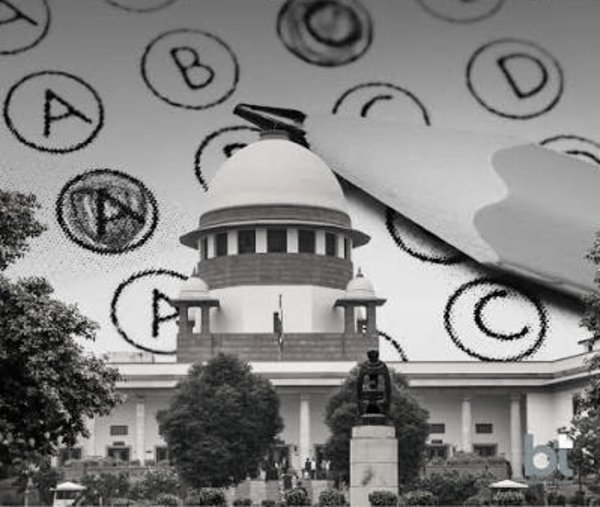
The Supreme Court has indicated that it wants to examine the National Testing Agency’s new headquarters in Delhi as part of proceedings concerning the restructuring of the agency and the conduct of NEET. The court has raised questions about the NTA’s infrastructure, manpower and functioning, while the Centre has been asked to submit an affidavit on the progress of a high-powered reform task force headed by Infosys co-founder Nandan Nilekani.
The development is important because the debate around NEET has gradually moved beyond individual examination irregularities. The question before the system now is whether the institution conducting one of India’s most consequential entrance examinations has the permanent structure and administrative capacity needed to manage it.
Justice P S Narasimha and Justice Alok Aradhe, while hearing petitions concerning the restructuring of the NTA, indicated that the court could visit the agency’s new headquarters at Minto Road. The court also stressed the importance of a permanent office and a substantial proportion of permanent staff rather than dependence on deputation.
Why the NTA’s structure matters to students
NEET is not an ordinary competitive examination. It determines access to medical education for a huge number of students across the country, making the reliability of the testing system directly relevant to students, parents, medical colleges and the wider healthcare education pipeline.
An examination can be conducted digitally, securely and efficiently only when the organisation behind it has adequate systems and personnel. Question-paper security is important, but so are examination centres, technology, data management, grievance handling, result processing and communication with candidates.
The Supreme Court’s focus on institutional structure therefore widens the reform conversation.
The Nilekani panel is approaching a deadline
A high-powered panel led by Nandan Nilekani has been examining possible structural reforms to NEET and the wider examination process. The panel is expected to submit its first interim report to the government by the end of September. It has consulted stakeholders and members of an earlier committee headed by former ISRO chairman K Radhakrishnan.
The court has asked the Centre to provide an update on the panel’s work. That creates a near-term point at which several strands of the NEET reform debate could come together.
The government’s position, as reported in the proceedings, is that the upgraded NTA system has provided greater permanence to the organisational structure, although human resources are only partially in place.
What students need from a reformed testing system
For students, institutional reform has one practical objective: predictability.
Candidates need to know that examination rules will be clear, centres will function properly, technical systems will work, results will be processed accurately and grievances will have a defined mechanism.
A stronger institution does not eliminate every possibility of error. It does, however, create clearer responsibility when something goes wrong.
The reform process also needs to consider the enormous scale of NEET. A system serving students from different states, languages, educational backgrounds and economic circumstances cannot rely entirely on informal arrangements or temporary staffing.
The test is now bigger than NEET
The NTA’s restructuring debate has implications beyond one examination. India conducts several large national-level tests through centralised examination systems, and the experience of NEET has exposed the administrative pressure that comes with conducting high-stakes examinations at enormous scale.
The Supreme Court’s proposed visit to the NTA headquarters is therefore unusual in one specific sense: it brings the institution itself into focus.
The court has not yet delivered a final blueprint for restructuring the agency. The Nilekani panel’s recommendations are also still pending.
The next major step is expected by the end of September, when the panel is due to submit its interim report to the government.
