
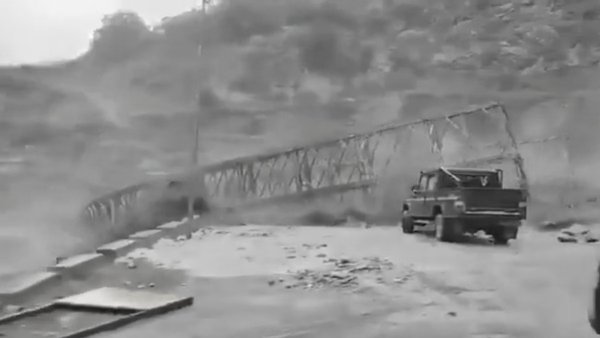
Kathmandu: Several lives lost, and a number of people missing and property destroyed by a massive sudden flood in northern Nepal, that has swept away homes, bridges, and vital infrastructure in Rasuwa district along the border with China.
The sudden surge has already hit various towns and settlements, including Timure and Syaphrubesi, in the close vicinity of the Nepal-China border crossing, by early Wednesday in the river Bhote Koshi. The scope of destruction and the loss is far-reaching, as rescue workers are unable to enter some parts of the worst-hit region of the flood to continue their searches.
The death toll confirmed, up to afternoon Wednesday, was of 7 people, while rescuers managed to save about 25 individuals and 9 members of armed police force at Timure were reportedly missing- according to reports by Nepal’s Kathmandu Post- although, Reuters confirmed the reported number was more than 9 deaths on Wednesday- citing concerned officials- cautioning that the final toll could increase due to widespread destruction.
Various numbers have been revealed according to different reports/departments, owing to the dynamic nature of the situation- with,communication disrupted to most of the affected areas and government still struggling to find out the extent of the damages.
Damaged road leading to China border: Entire connection severed
Nepal’s Department of Roads is now indicating the extent of damages.
It said the highway- 42- kilometer route from Betrawati (Nuwakot) to Rasuwagadhi border crossing point- was swept away with several concrete bridges that once formed a part of it now buried under torrents. Officials said damage to another 16-kilometer part near the border crossing were yet to be ascertained and monitored closely.
Road connection to China via Rasuwagadhi is one of the major land links, for Nepal and consequently, its economy through trade. The flood is expected to disrupt trade and commerce for an uncertain period of time. It may be worth noting that, the same corridor that had been damaged in a flood last year has been again hit by an unforeseen flash flood now. Construction, that has been ongoing in the corridor, was also assisted by China’s funding for upgraded sections of the road.
Rescue efforts in steep terrain encounter difficulties
Nepal Army, Armed Police Forces and Nepal Police have been deployed at the time of reporting to rescue stranded citizens trapped by the floods.
Army’s helicopters were deployed, while policemen are in the fray trying to move those trapped towards safe points in difficult areas- where roads have vanished. Kathmandu Post has reported 14 helicopters air-lifting survivors across the region, although some parts remain completely inaccesible. Several citizens, trapped in the region’s hamlets, have been airlifted by the Army while the medical assistance were also moved toward these remote regions. Simultaneously, the authorities are also assessing risks in down streams and moving residents away to safer locations away from the River Trishuli.
Power generation cut:430 MW affected
The surge of flood has also inflicted irreparable damage on the power sector. It is reported byReuters that,430 MegaWatts,equivalent to more than 12% of Nepal’s total power capacity generation from the countries largest sector-hydropower – has been impacted. Likewise, Nepal Views confirmed that at least five operating power plants totaling 236 MW capacities have stopped electricity generation.
The figures of power loss in still uncertain although the sector has undergone substantial loss from flood disasters- a problem many would say befalls power infrastructure from floods in such treacherous regions time and again.
What caused flood? The ultimate question: Unknown!
No clear reason has been established for such a sudden flash flood. Officials of Nepal government have confirmed only initial details with possibilities such as landslides creating a damn in the river system of the Tibetan plateau, that eventually breached resulting into huge volumes of water to cascade downhill causing floods at nearby river systems. That remains unconfirmed reports. The flood origin lies in Tibetan region before flowing down into the river systems in Nepal- and then merging into the river Trishuli.
Hence, the region’s proximity to Tibetan highlands makes it very important not only to Nepal- but to the greater river system in general.
How India watches- in an effort to combat flood, from below
The river system converges at some downstream areas to form the Gandaki River system that ultimately flows into India. Nepal authorities had alerted River communities downstream- monitoring the flows of river water. For India, this could become an additional concern along Bihar- that was already reporting water levels close to or above warning level along the river Gandak.
Flood watch systems showed River Gandak flowing above danger levels at Dumariaghat while at some other points of monitoring, it was also observed to be running above warning level on August 26th, 2026.
Although the above observation may not directly be linked to this recent Nepal disaster, but with existing water flows higher than normal, this certainly poses future concerns. A major downstream disaster could now unfold more complicated if continued heavy water flow is reported.
Still the worst is yet to come. For the government of Nepal, rescue and humanitarian efforts are now priority number 1 including free treatment of casualties from emergency shelters. Immediate objectives like ensuring survivors receive immediate and adequate help and aid from across regions, rescue and search for missing victims, and road construction are being undertaken.
However this calamity is now raising serious concern towards stability of villages in higher altitudes as they stand highly vulnerable.
For, a loss for Nepal- becomes a concern across border if it spreads beyond the designated disaster areas. Nepal is facing, in addition to casualties, loss of its infrastructure vital to trade and economy; the recent flood in the Himalayan nation serve us all a notice regarding risks that can rapidly elevate into regional concerns from natural disasters once they get control of river systems at extreme highlands. Search efforts are still under way for missing bodies in this colossal flood-calamity and the actual human loss may reach far more in days to come.
